
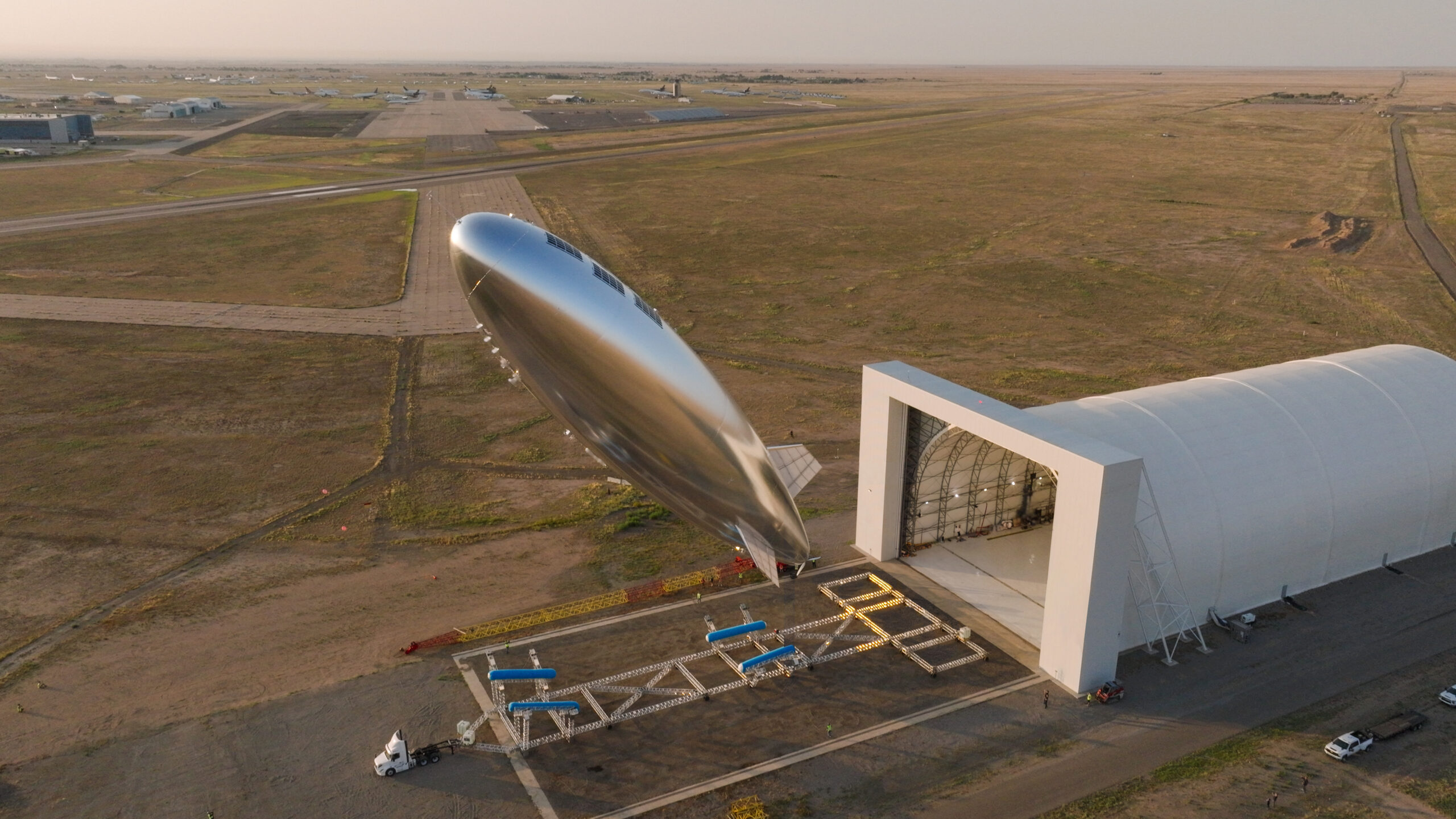
Nearly 100 years after the dirigible Graf Zeppelin made the first nonstop airship journey across the Pacific Ocean, another airship has completed a round-trip flight from New Mexico to Japan and back. The significance of this modern feat lies less in the journey's length and more in its purpose: demonstrating how a lighter-than-air platform can act as a cell phone tower in the sky. The trans-Pacific flight, which took place over a month between August and September 2026, was the most notable milestone yet for Sceye, a US aerospace company based near Albuquerque, New Mexico.
Sceye's uncrewed platform is filled with helium for buoyancy and equipped with an electric-powered propeller, allowing it to resist most strong winds and hover over the same location for long periods. Top-mounted solar panels and onboard batteries keep it powered around the clock. "We can stay over an area of operation, and we do that in the stratosphere right around 60,000 feet, so we're twice as high as air traffic and we're above the jet stream, and yet 30 times closer than low-Earth orbit satellites," said Mikkel Frandsen, founder and CEO of Sceye.
Sceye began testing smaller prototypes in 2016 and reached the stratosphere with a 215-foot (65-meter) version in 2021. The latest version extends to 270 feet (83 meters). Frandsen credited advances in materials science, such as the discovery of graphene in 2004, with improving the hull's strength-to-weight ratio and battery and solar panel performance.
The design could eventually scale to a high altitude platform system (HAPS) capable of lifting payloads of 551 pounds (250 kilograms). A single platform could one day provide mobile broadband coverage equivalent to 500 ground-based cell towers, which may prove useful for both commercial telecommunications and emergency coverage during disasters.
Source: Ars Technica · Summarized by HeadlinesBriefing