
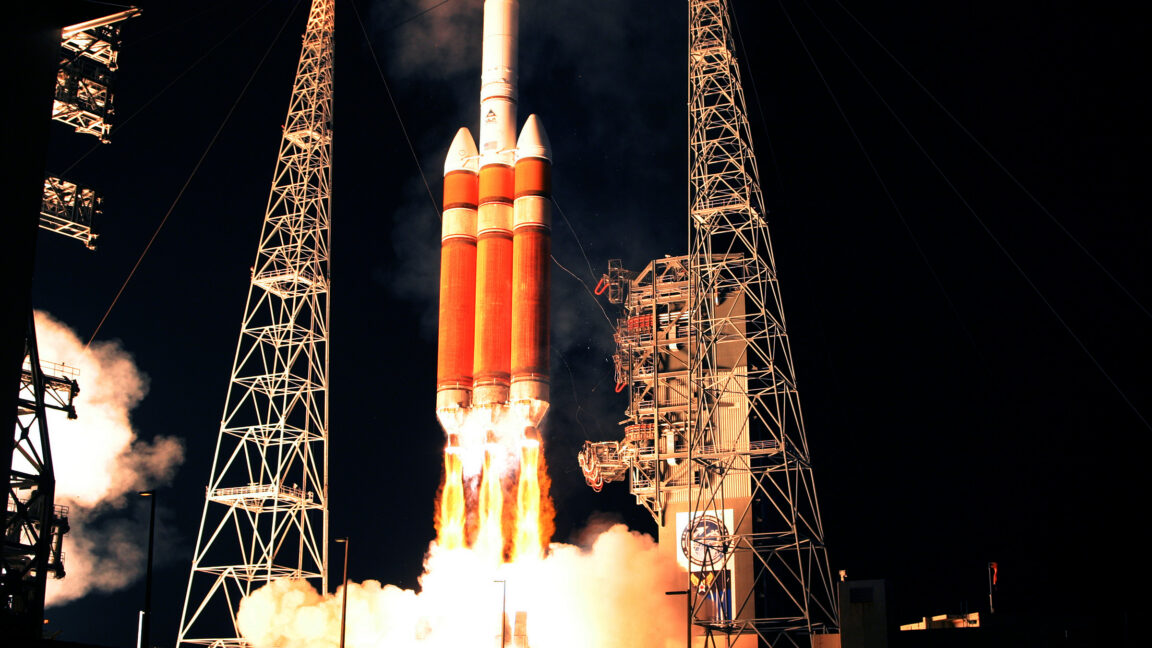
In late 1970, a Titan IIIC rocket launched from Space Launch Complex 40 at Cape Canaveral Air Force Station, carrying a top-secret payload for the US military. Much has changed in spaceflight since then. The Titan IIIC would bow out in 1982 after dozens of launches. Various Titans continued launching from Space Launch Complex 40 until 2005, at which point the US Air Force—in a competitive process hotly opposed by United Launch Alliance—turned the pad over to a small, largely unknown startup called Space X. And Cape Canaveral is now a “Space Force” station.
But those unspecified payloads? Until last month, some of them were still flying operationally. The US government would later disclose that the top-secret payload that launched in November 1970 was a “Defense Support Program” satellite. The initial block of these satellites, launched from 1970 to 1973, had a mass of about 1 metric ton, and each carried about 2,000 infrared detectors. They were essentially very sensitive telescopes, and each satellite was launched into geosynchronous orbit.
For a time, these were among the most important satellites flown by the US, as they served to detect the launch of a nuclear warhead at the country. As a result, the Defense Support Program would become one of the primary elements of American military space power during the Cold War. These initial satellites transformed experimental infrared observations into an operational program that continuously monitored the globe for missile launches. Initially built to identify Soviet ICBMs, they were essential for nuclear deterrence; later, they also became useful in conventional warfare, such as detecting Iraqi Scud missile launches.
Over time, the military added to the constellation, improving reliability and expanding their capabilities. Each satellite ended up having more than 6,000 infrared detectors and a mass of about 2.5 tons. Satellites in the Defense Support Program kept on flying into space until 2007. One of them, DSP-16, even launched on a space shuttle (Atlantis) in 1991.
Source: Ars Technica · Summarized by HeadlinesBriefing