
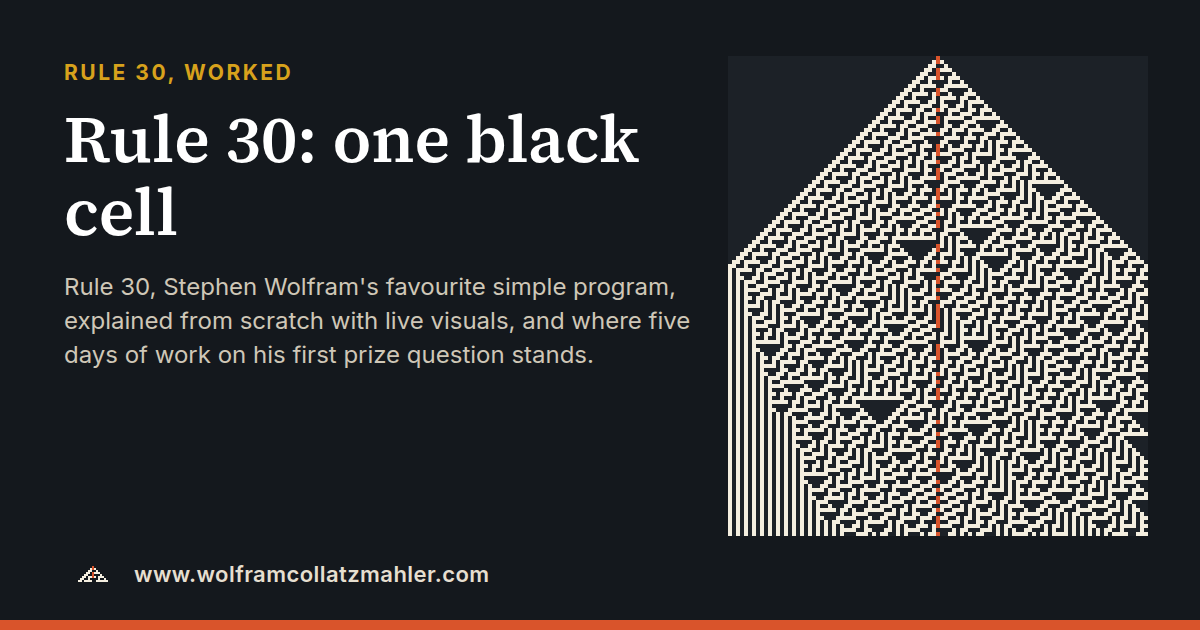
A simple program, a forty-year question. Start with a single black square and apply one tiny rule, row after row. What grows is part orderly, part wild, and nobody can yet prove whether the column running straight down its middle ever repeats. As each row appears, its middle cell is read off into a strip on the right, and so far it looks exactly like the tosses of a fair coin.
The rule is one you could run with a pencil. Each square in a new row is determined by three squares above it: the one directly above and its left and right neighbours. Those three colours can combine in eight ways, and the rule states the new colour for each combination. Written as a binary number, the eight answers give 00011110, which is 30. In words, the new square is black when the square above-left differs from "the square above or the one above-right is black."
In the early 1980s Stephen Wolfram set out to examine the simplest possible programs of this kind. Most of the 256 options die out, repeat, or form neat nested patterns. Rule 30 does not. Its left side settles into regular stripes, while its right side never settles, and its centre column passes standard tests of randomness. For many years it generated Mathematica's random integers, and its pattern decorates the walls of Cambridge North railway station.
On 1 October 2019, Wolfram offered $30,000 in prizes, $10,000 for each of three open questions about the centre column. Does it ever become periodic? Does each colour occur equally often in the long run? Does computing its nth cell require at least n steps? The column is not truly random, since every cell is fixed by the rule, so each answer is yes or no and only a proof can settle it. Computing a billion cells has shown no pattern, but that proves nothing.
Source: Hacker News · Summarized by HeadlinesBriefing