
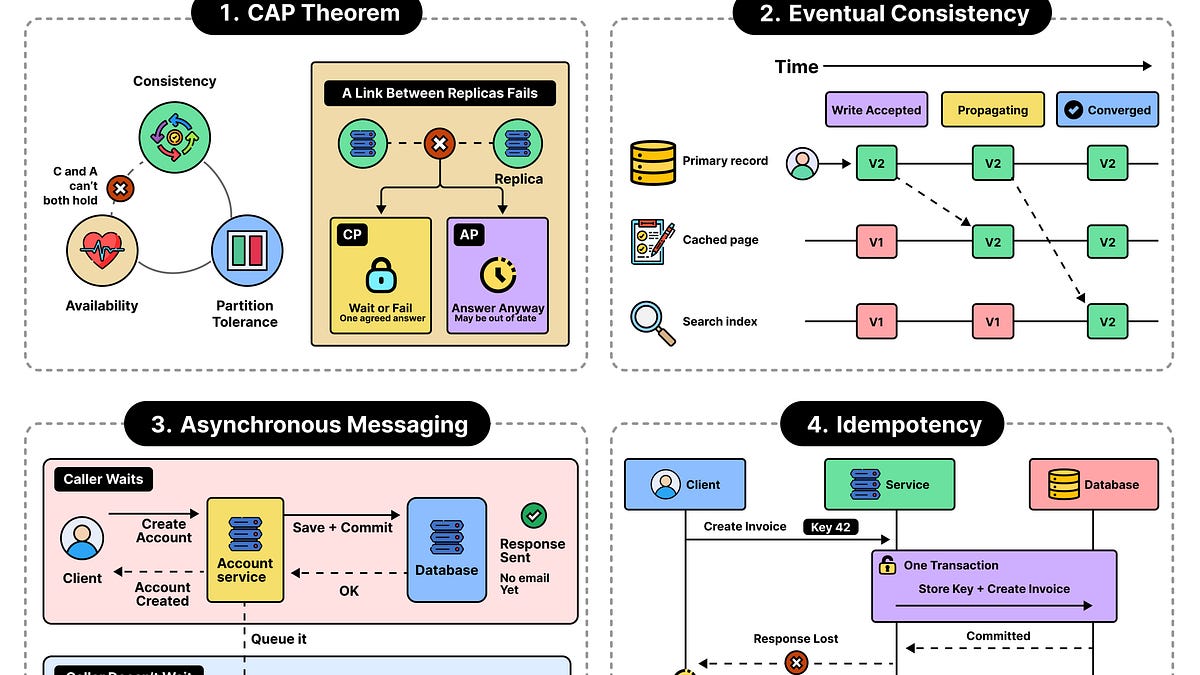
In a distributed system, components run in separate processes or on separate machines. These components can be application services, database replicas, or background workers. Because the system is divided into so many parts, it is common for one component to need to talk to another to get something done, and it may have to wait for that component's response.
You can think of coordination as this talking between components. For example, one service may wait for another service to approve a request. A database may wait for acknowledgment from its replicas. A worker may wait for a lock. Each of these waits adds dependency, and dependency is where distributed systems run into trouble.
This article examines why coordination is a challenge for distributed systems. It covers why coordination becomes difficult, how coordination grows as a system scales, and how it can be reduced. Designers who minimize the points where components must wait on one another can build systems that are more resilient, more scalable, and easier to operate.
The central idea is that independence is usually preferable to coordination. Where a component can make progress on its own, without waiting for others, the system tends to tolerate failures, latency spikes, and load more gracefully. The strategies for handling coordination, when it cannot be avoided, are the focus of the sections that follow.
Source: ByteByteGo · Summarized by HeadlinesBriefing