
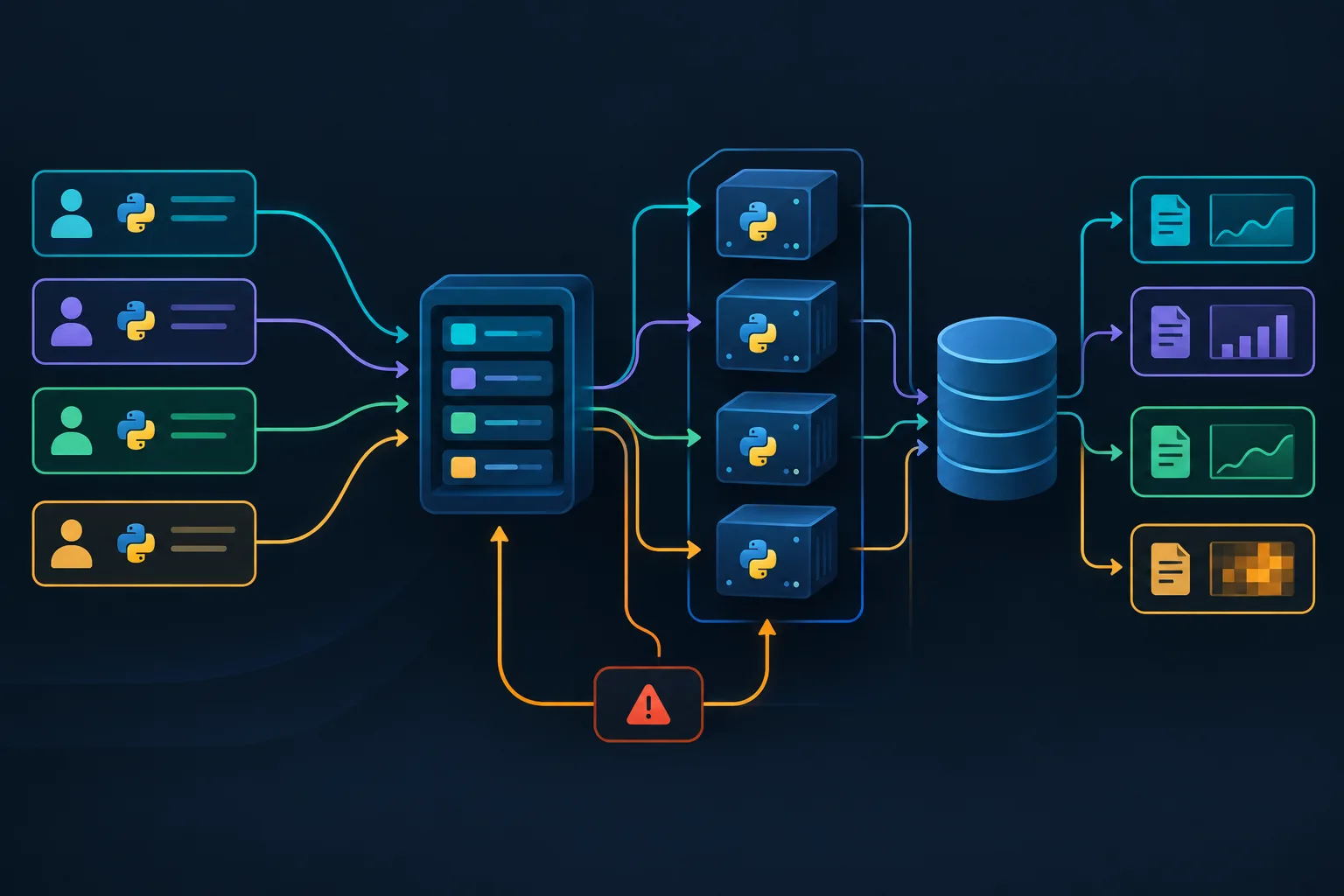
A long-running Python simulation looks like a compute problem only while one person runs it. Once several people depend on it, the difficulty shifts to queueing, failure recovery, job visibility and reproducibility. Requests arrive faster than jobs finish, some runs die halfway through, and people expect past results to be reproducible on demand.
The author argues that the real engineering lies in the gap between a program that works and a service people can rely on. Model evaluation and batch processing face the same problem. Running code once is easy; running it repeatedly for many users, so that every run can be found, traced and repeated without interfering with others, is a different kind of job.
During work on AWS-based transportation simulation infrastructure at Amazon UK, the bottleneck was not compute. The workflow was largely manual, with operators handling inputs, configuration and infrastructure setup by hand. Every new request consumed engineers' attention before any compute was used, and failed runs were hard to trace because evidence was scattered across inputs, configuration and machines. Adding machines would have raised the theoretical ceiling but left queueing, isolation between runs and duplicate execution unsolved.
The question therefore shifted from how to run simulations faster to how to let several people submit work safely, observe each job's status and recover when something breaks. The author's core claim is that, once multiple people depend on long-running simulations, the real problem is job control, which breaks down into smaller concerns: queueing, state management, isolation, recovery and traceability.
Source: Towards Data Science · Summarized by HeadlinesBriefing