
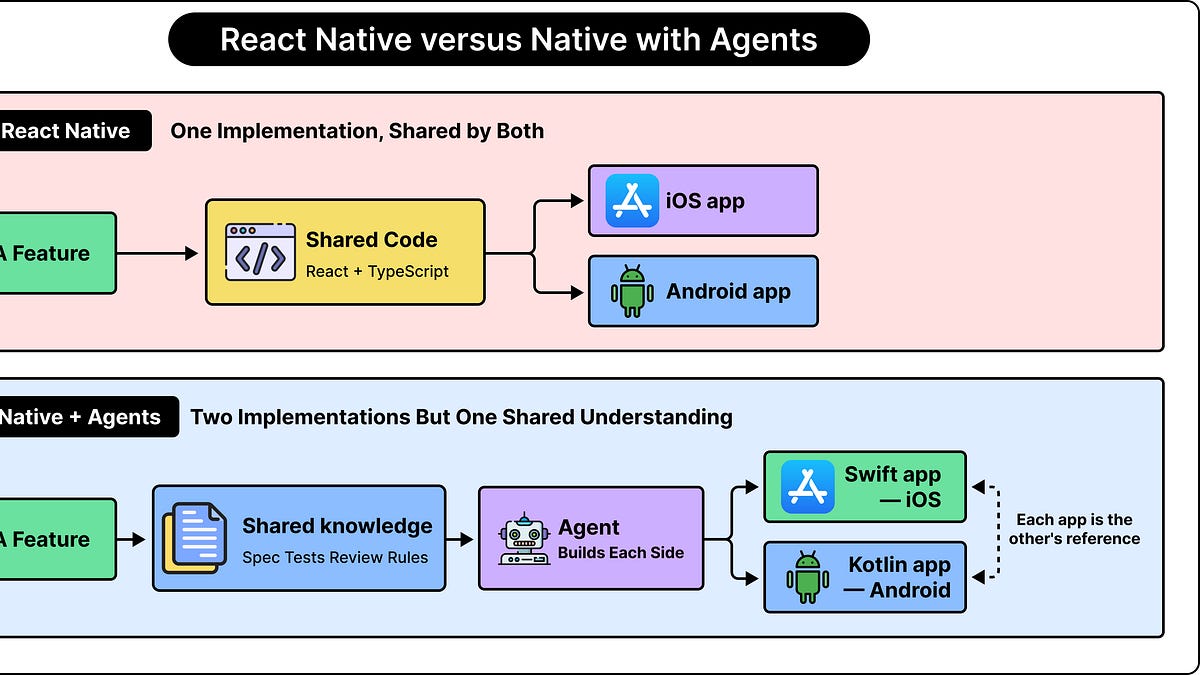
In 2020, the Shopify engineering team decided to go all in on React Native. It saved them a lot of time and money. Using React Native, developers did not have to implement the same feature separately in Kotlin and Swift to work on Android and iOS. The framework came with its own requirements, but the approach was very successful at the time.
In 2026, however, AI coding agents have changed the economics of building mobile apps. Previously, React Native's savings could justify its tradeoffs. Now AI agents are so capable at writing code that building the same feature natively in Swift and Kotlin is much cheaper.
Native mobile development means building an application directly with a platform's languages, frameworks and tools: Swift and SwiftUI for iOS, and Kotlin and Jetpack Compose for Android. Building natively for both platforms requires maintaining two client implementations, although backend services can still be shared. React Native lets developers share much of the implementation across both platforms by sitting on top of native UI components, though platform-specific code and separate build, test and release processes still remain.
This article examines how Shopify decided to move away from React Native, how it approached the migration to native development, and the results. The source notes that details are drawn from publicly shared information, and readers are invited to point out any inaccuracies.
Source: ByteByteGo · Summarized by HeadlinesBriefing