
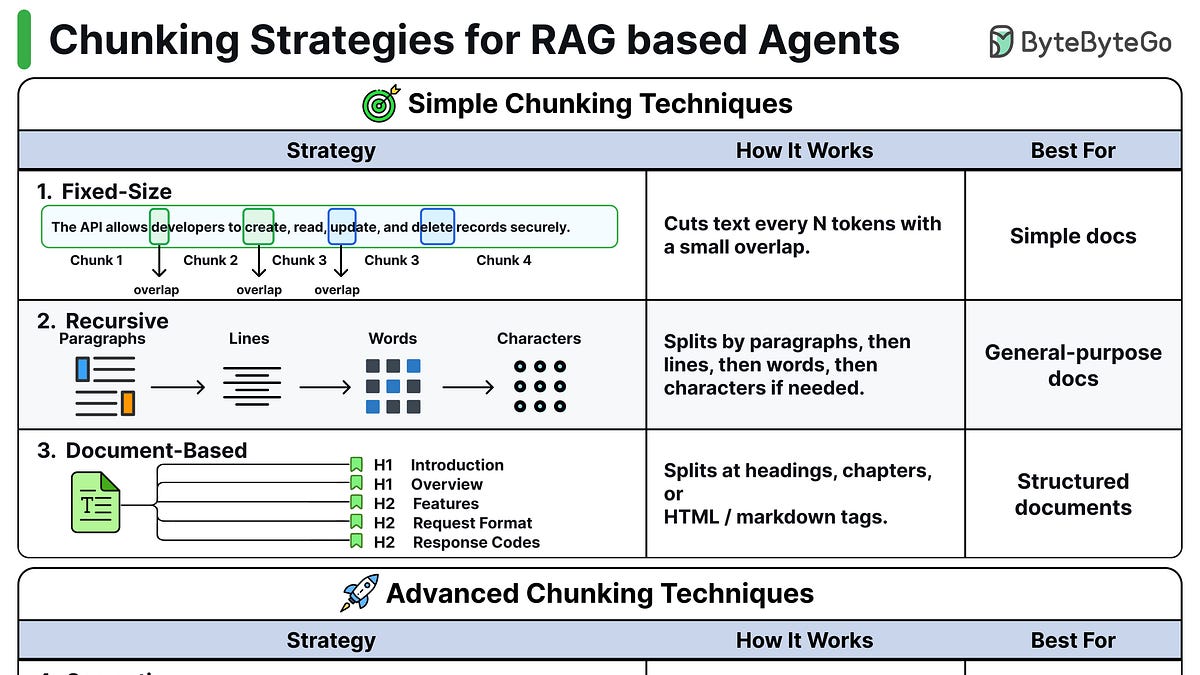
This article outlines eight chunking strategies used in retrieval-augmented generation (RAG) systems to improve how large language models process text. Fixed-Size chunking divides text into uniform token blocks with overlap. Recursive chunking splits by paragraph, then line, word, and character as needed.
Document-Based chunking uses existing structural breaks like headings or HTML tags. Semantic chunking embeds sentences and starts new chunks when similarity drops, detecting real topic shifts. LLM-Based chunking uses an LLM to rewrite text into standalone propositions, one idea per chunk—high quality but costly.
Agentic chunking lets an AI agent classify documents (e.g., code, contract) and select the optimal method per file. Late Chunking runs the full document through an embedding model before splitting and mean-pooling within boundaries. Hierarchical chunking creates layered structures from sections to sentences.
The piece also briefly touches on related topics like Google Translate’s architecture, agent skills workflow, and PostgreSQL’s process-based design, ending with reflective questions for readers.
Source: ByteByteGo · Summarized by HeadlinesBriefing