
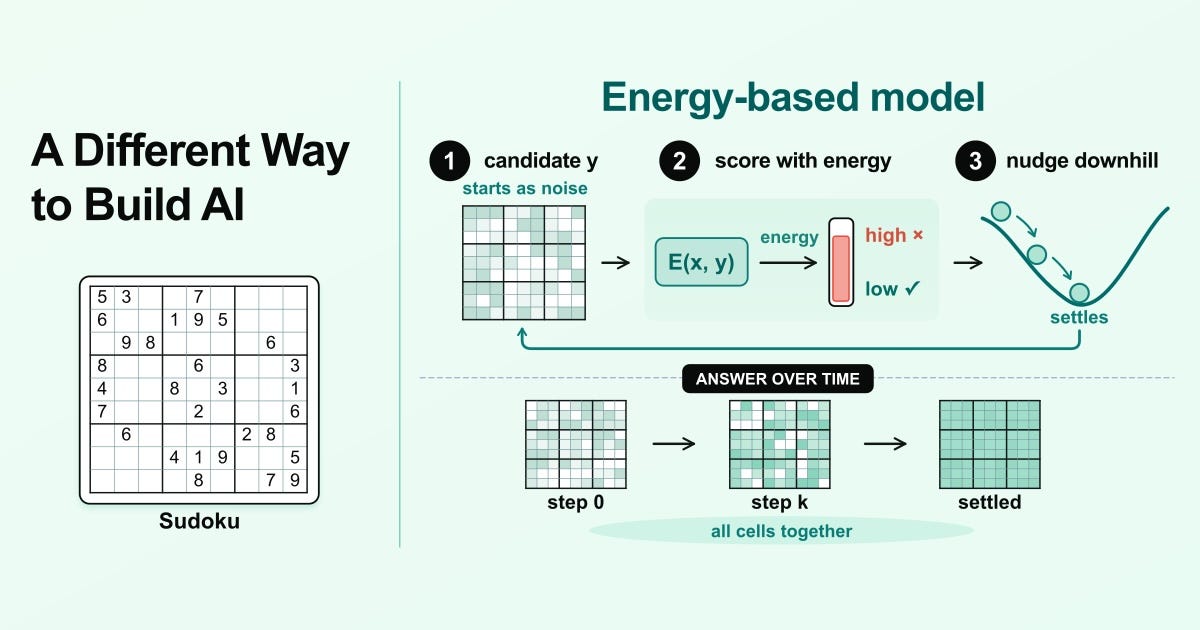
A public Sudoku experiment this year produced a striking result. According to Logical Intelligence, a panel of frontier large language models, including OpenAI's GPT-5.2, Claude Opus 4.5 and Sonnet 4.5, Gemini 3 Pro, and DeepSeek V3.2, collectively solved only 2% of the puzzles and burned around $11,000 in API calls. A model named Kona, about a thousand times smaller, solved 96.2% for only $4 in GPU time.
The gap is not really about Sudoku. Sudoku's rules are well-defined and simple enough for a ten-year-old to learn, which is exactly why the result is surprising. LLMs are the most capable AI models built around language, but many everyday tasks require intelligence beyond language. Some demand spatial or dimensional reasoning, others depend on logic, planning, or emotional awareness, and much of what people do cannot be fully verbalized. Extrapolation and creativity are what make intelligence feel alive rather than mechanical.
Yann LeCun, a Turing Award winner and deep learning pioneer, has argued for years that text alone will not produce real intelligence. The approach of Logical Intelligence, founded by Eve Bodnia, relies on energy-based reasoning models (EBRMs) such as Kona. These models are designed to handle constraint problems that LLMs struggle with.
LLMs work by predicting the most plausible next token in a sequence. This design has produced strong results in translation, summarization and code generation, but it is not well suited to every problem. For tasks that require other forms of intelligence, EBRMs offer a different path, with latent reasoning that is more reliable and verification and safety handled differently from LLM systems.
Source: ByteByteGo · Summarized by HeadlinesBriefing