
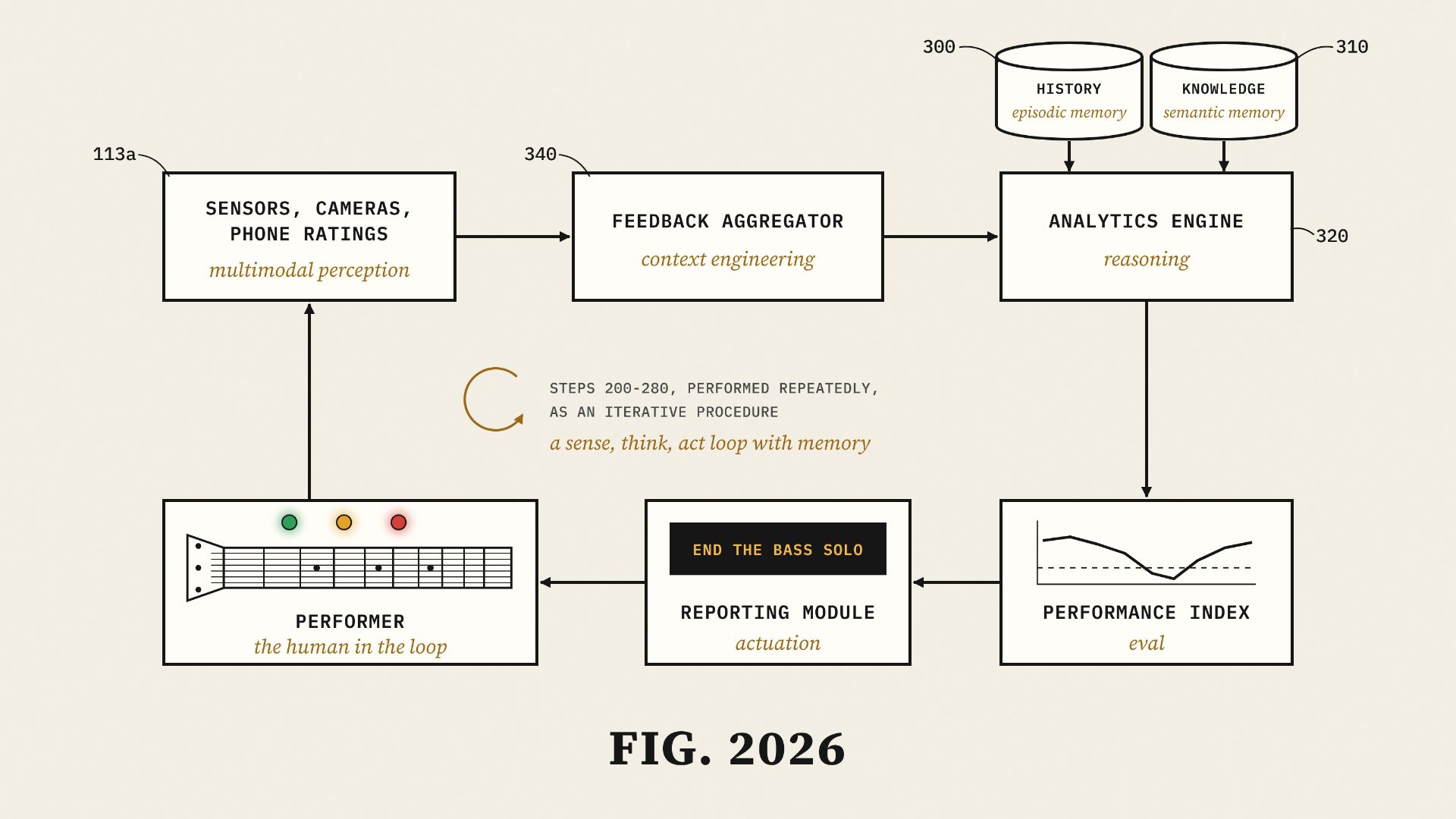
In November 2016, three colleagues and I at IBM filed a patent application titled "Real-Time Analysis of a Musical Performance Using Analytics" (published as US 2018/0137425 A1). The scenario was a rock concert: a guitarist's instrument carries an embedded sensor, cameras read the audience's faces and body language, and fans send likes and dislikes from their phones. A system fuses all of this in real time into one judgment about whether the performance is going well, and alerts the performer while there is still time to fix it. In one embodiment, an LED on the guitar neck shows green for correct playing, yellow when the tempo wavers, and red on a wrong note. We called the core an "artificially intelligent analytics engine," because that was the vocabulary we had in 2016.
Ten years later, I design data architectures for agentic AI systems in production. Re-reading the patent, I was struck by how closely it matches the anatomy of an AI agent: multimodal perception, context aggregation, inference grounded in episodic and semantic memory, an evaluation function, and actuation through a human in the loop, all under a hard real-time constraint. We did not have the language for it, but we had the loop.
The specification has seven parts. Perception operates in three modalities: sensors in instruments report timing, pitch, intonation and volume; cameras capture involuntary audience signals; and a network path carries deliberate feedback such as ratings and comments. A feedback aggregator tags, sorts and reformats these inputs, which today would be called context engineering. The analytics engine then infers the performance's characteristics, grounded in a repository of archived past performances and a knowledgebase that gives feedback semantic meaning.
The mapping is not perfect. The design got the structure of agents right but missed other issues, and those gaps still teach agent builders useful lessons today.
Source: Towards Data Science · Summarized by HeadlinesBriefing