
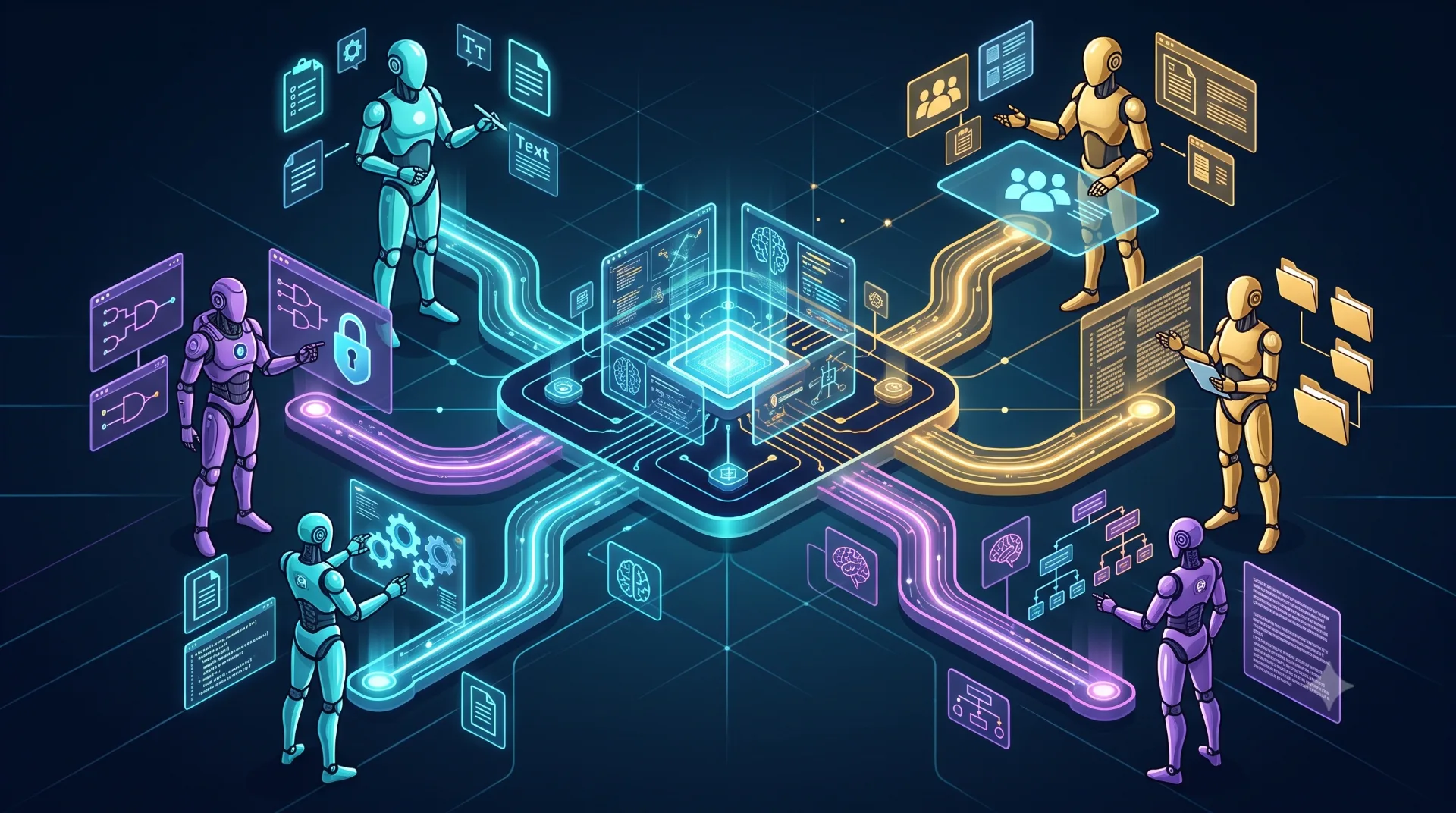
Moving an AI agent from proof-of-concept to a reliable, production-ready enterprise workflow requires it to meet standards of scalability, responsiveness, and cost-effectiveness. Agents are needed because conversational insight from data is often not enough. LLMs can plan, reason, and act, and agents are the logical constructs around the LLM "brain," using tools, interacting with external APIs, correcting their own mistakes, and collaborating with other agents.
Agentic systems rely on many high-frequency decisions, such as what the next step should be, which agent should handle it, which tool to use, and whether there is enough context to respond to the user. A major evolution is the arrival of low-cost calibrated decision models, such as Type Safe's JEV, which shift deterministic workload away from LLMs so they can focus on deep reasoning and synthesis. Like retrieval, the broader agentic landscape is moving away from naive single-agent loops toward heavily engineered multi-agent workflows and constrained architectures.
The article offers a practitioner's deep dive into six architectural patterns, examining how each works, visualizing its data flow, and explaining the role of Context Engineering in managing the LLM's working memory. An agent consists of four pillars: a core LLM that orchestrates logic, tools and actions, planning and control flow, and memory.
Context Engineering is a key criterion for production readiness. An agent's context is highly dynamic, accumulating observations, errors, and intermediate thoughts with each action. Appending everything to the prompt bloats the context window, increasing latency and cost, and can cause the LLM to lose track of granular facts. One core technique is State Projection, which injects only the context strictly necessary for the current workflow step.
Source: Towards Data Science · Summarized by HeadlinesBriefing