
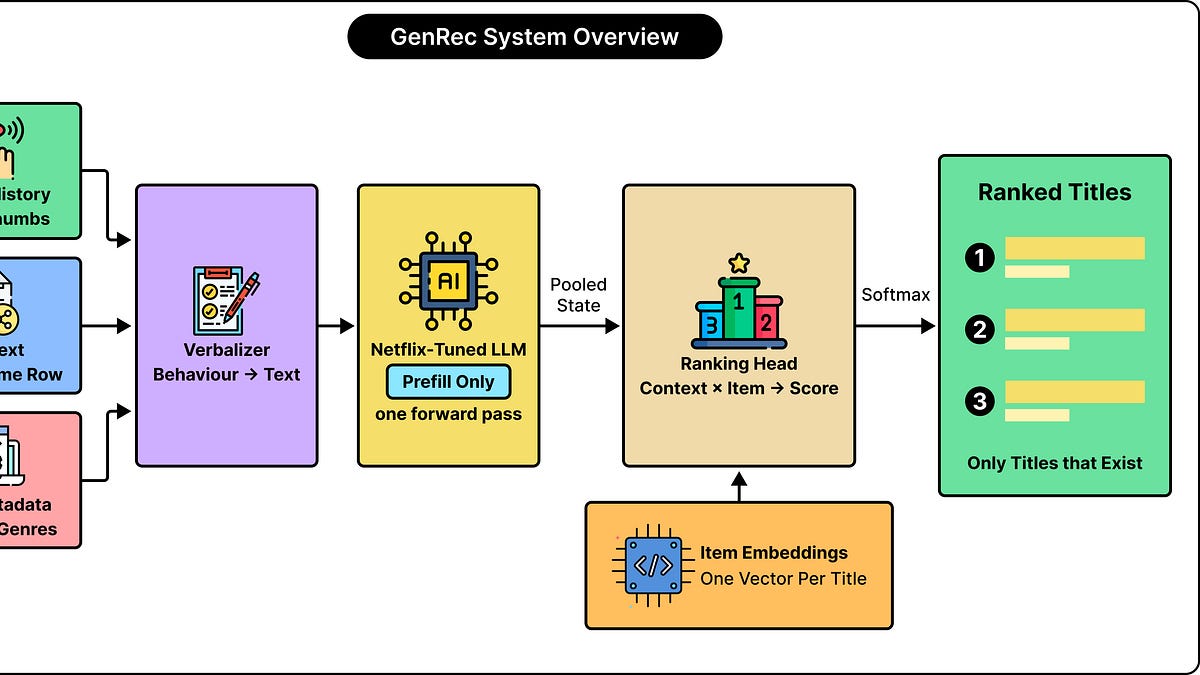
Recommendations are one of the most important pieces of the Netflix experience. The original Netflix recommendations engine was built on top of 1000s of hand‑crafted features across users, items, and interactions. Though a lot of changes have happened to this stack over the years, it’s still pretty complex. It’s costly to onboard new use cases.
Large language models (LLMs) have made great strides in their ability to recommend things to a user. Due to their broader world knowledge and understanding of language, LLMs do a good job of figuring out relationships between different things. However, you cannot just pick an LLM off-the-shelf to generate recommendations for a company like Netflix. This is why the Netflix engineering team built Gen Rec.
The basic idea behind Gen Rec is to use an LLM to make better sense of a user’s viewing history to assign scores to the various movies and TV shows streaming on Netflix. Netflix has to make a bunch of adjustments to the base model to make it work with their content and member behavior.
A recommendation system has to answer a basic question: What should appear first in the list of recommendations? The ordering of the recommendations is handled by a component known as the ranker. It assigns scores to various items based on how suitable they appear for a particular user in a particular situation. The better an item’s score, the higher it appears.
Source: ByteByteGo · Summarized by HeadlinesBriefing