
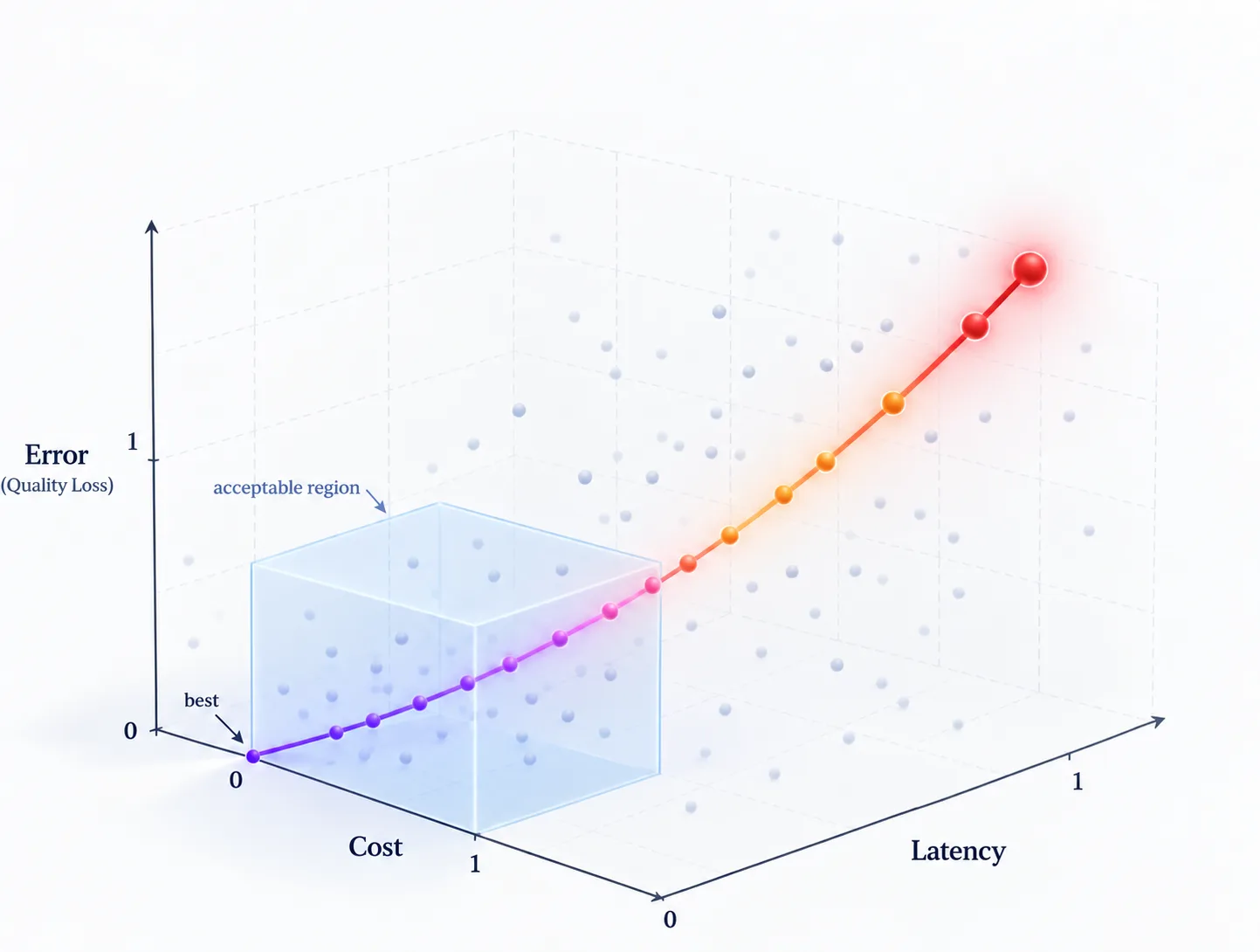
This article tackles a practical problem in production agent systems: merging competing evaluation metrics into a single, meaningful score that reflects multi-team objectives. Teams must balance accuracy, cost, speed and reliability, and optimizing one dimension often hurts another.
The author argues that most teams already have the ingredients, including Jira tickets, PM requirements, finance budgets, SLOs, support tickets, traces and eval datasets. What is often missing is a translation layer between business objectives and agent configuration decisions. Product sets quality floors, finance sets cost ceilings, engineering sets latency and reliability thresholds, and risk sets policy constraints. Each agent configuration is then scored against the same shared box.
The cost of ignoring this trade-off is measurable. Citing the CLEAR framework, the article notes that agents with similar accuracy can differ in cost by up to 50 times, and that agent success fell from 60% on a single run to 25% when measured for consistency across eight runs. These findings come from one preprint, but the author says the direction matches what many teams see in production.
The core principle is to stay inside the box first, then optimize within it. Component metrics remain necessary to explain why an agent failed, but a single composite score prevents a model that improves quality while pushing latency past customer patience limits from becoming a repeated debate. The article defines the box in plain language, builds a scoring function in about 40 lines of NumPy, compares two sample configurations, and shows how the score can plug into evaluation tools such as LangSmith, Phoenix and DSPy.
Source: Towards Data Science · Summarized by HeadlinesBriefing