
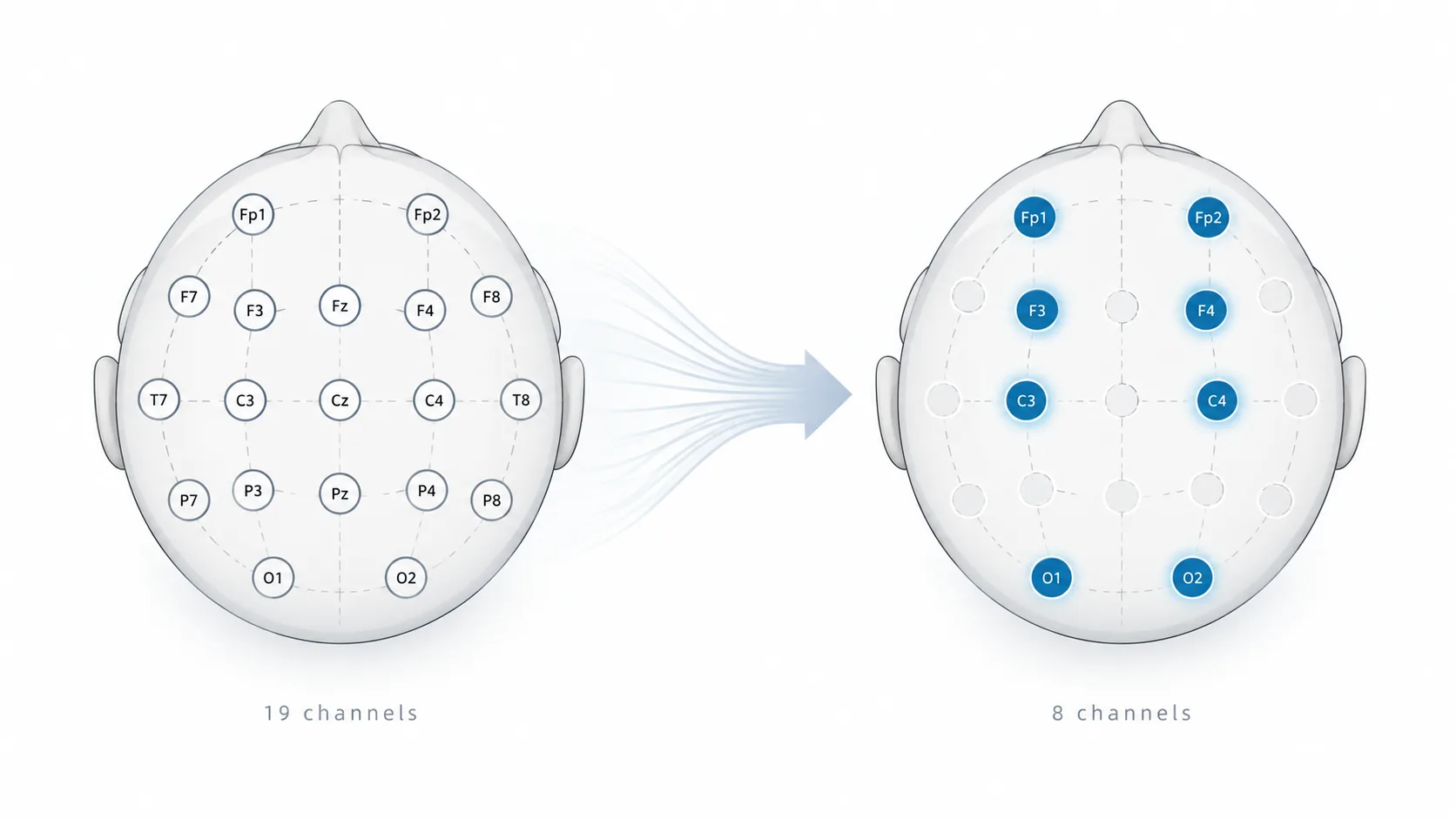
Machine-learning pipelines often assume that more measurements yield better results, but in sensor-based systems each extra EEG channel adds electrodes, signal streams, setup complexity and processing cost. This analysis tests whether all 19 scalp EEG channels in a public mental-arithmetic dataset are needed for cross-participant classification, reducing the montage to 12, 8, 4, 2 and 1 channels while keeping the same preprocessing, spectral features, model families and participant-held-out evaluation.
The EEGMAT dataset from PhysioNet contains 36 participants, each with a background recording and a serial mental-arithmetic recording. The classification target is the recording condition, not a validated universal measure of cognitive load. Signals were filtered from 1 to 40 Hz, split into four-second windows, and relative power was computed in theta, alpha, beta and low gamma bands, yielding 76 features per window across 2,134 windows.
Large reductions in channel count produced only small changes in unseen-participant performance. More revealing, several electrodes ranked near the top in nearly every training fold, yet they did not outperform randomly selected channel subsets on held-out participants. The experiment therefore shifted from finding an optimal EEG montage to a broader lesson: stable feature importance does not necessarily mean better out-of-sample usefulness.
The work builds on earlier findings that validation method strongly shapes reported performance. Holding out entire participants, rather than individual windows, gives a more realistic picture of how a model will behave on people it has never seen, which is the central requirement for practical deployment.
Source: Towards Data Science · Summarized by HeadlinesBriefing