
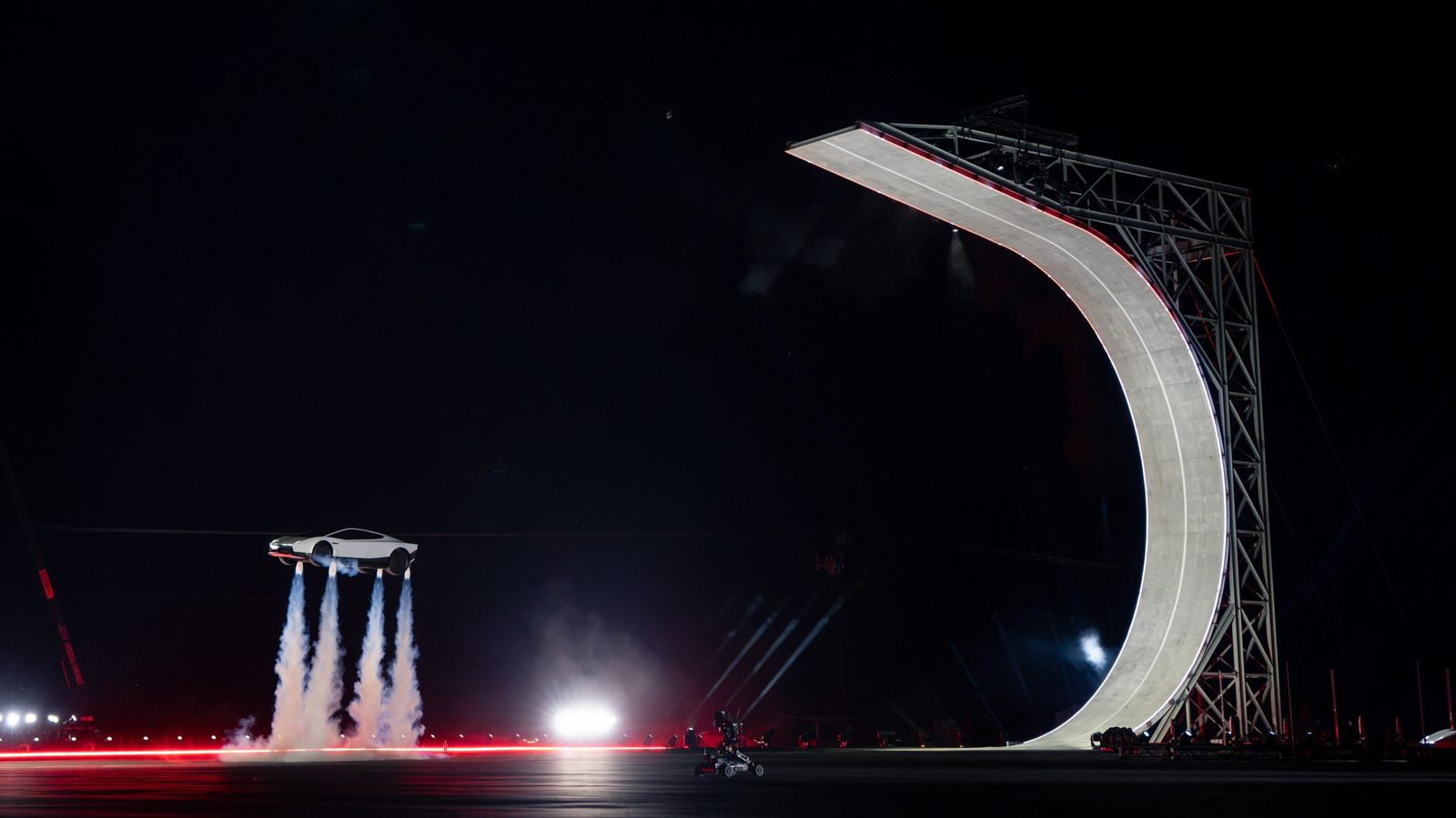
Tesla's long-delayed Roadster was formally reintroduced on October 15, and the company's biggest surprise was that the car can "fly." It can't truly fly like the car in Back to the Future Part II. Instead, it performs a series of controlled falling, jumping and flipping maneuvers. The concept isn't unique to Tesla. Experimental missile defense systems have used similar thrusters since at least the early 2000s, in a form factor now called a Multiple Kill Vehicle, or MKV.
The Roadster's kickflips are powered by two high-pressure air tanks and ten nozzles placed throughout the car, which fire compressed air to move and stabilize it. Tesla says the car can refill those tanks on its own. The full thruster setup is only available on the Rocket trim. The Thruster trim has thrusters only on the back, and the Performance trim has none. Tesla also states that the thrusters "aren't approved for public road use."
Lockheed Martin's MKV project began in earnest in 2004, when the company won a $760 million contract from the US Missile Defense Agency to build "the first system capable of destroying multiple ballistic missile threats and decoys with a single launch." The system carries several smaller vehicles designed to smash into missiles, and it uses thrusters to change direction and orientation quickly, much like the Roadster. Footage of the MKV is hard to find, and similar clips have also been linked to the Reagan-era Strategic Defense Initiative, better known as "Star Wars."
The two systems differ in how their thrusters work. Tesla insists the Roadster uses cold-gas thrusters, which means they don't burn fuel. A 2008 Lockheed Martin press release indicates the MKV went through hot-fire tests, suggesting part of its system burned fuel for propulsion. The MKV project was retired in 2009 as part of military budget cuts, and neither vehicle is currently owned by the public, so it's hard to say which approach is better. Tesla's design is presumably less combustible.
Source: Engadget · Summarized by HeadlinesBriefing