
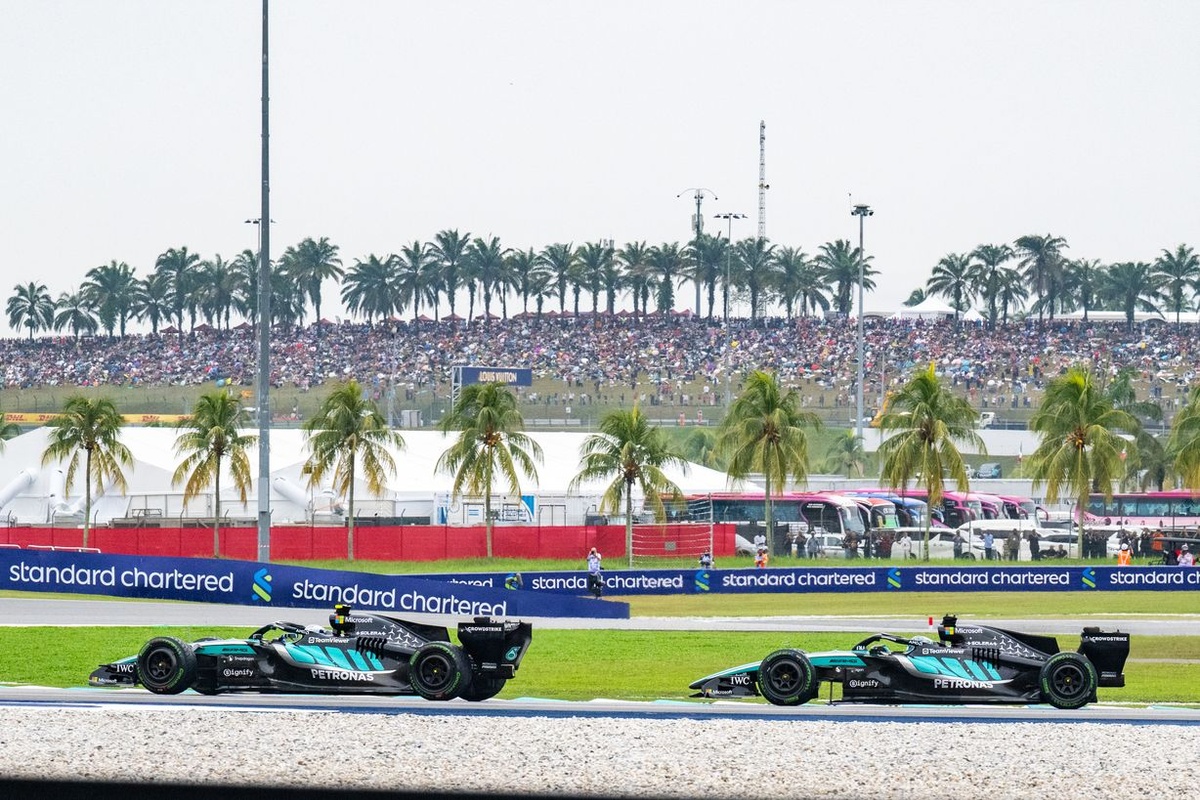
马尔代夫的巴林格罗普赛在马来西亚的表现需要进一步调查,因为塞朋赛道上的条件具有挑战性。该团队为F1在九年内首次访问塞朋的周末引入了修订的地板和侧罩包装,但在整个周末 struggle to unlock its usual top-line pace throughout the weekend. Regardless, it was set to pick up a double podium finish before George Russell retired with a powertrain issue late on. Through the weekend, the team declared itself happy with the performance of the update in higher-speed corners, but the W17 overall did not gel with the circuit - particularly around the slower corners.
In the team's usual post-race debrief circulated on its social media channels, deputy team principal Bradley Lord explained that the drivers were having to resort to slightly unusual inputs in those slower corners to get the car to bite. "The combination potentially of update, track temperature and track surface caused an interaction and a set of behaviours that meant the car was not in its usual happy state, that the drivers were having to turn the car on the throttle in the slow corners," said Lord. "That was further exacerbating the challenges with tyre temperature. So that's not an easy thing to unpick. Andrea Kimi Antonelli, Mercedes, Max Verstappen, Red Bull Racing Photo by: Joe Portlock / Getty Images "It's a bit of a 3D problem that we need to work through and then figure out exactly what steps we take going forward to make sure we've got the base understanding that we need to understand that the update is working well and that we're heading in the right direction in our development, not just for this year's car but for next year as well." So that's work that's going on at the moment back in the factory and also over in Singapore in order to establish exactly what the plan is for the coming days and the race weekend in Singapore.
Why Sepang's surface was a problem for more than just tyres There are two particular threads that link the track surface to the car, the most obvious being the interaction between the road and the tyres. The roughness of the circuit was a key factor in excess tyre heat, as the contact between the tyre and the surface produced greater levels of strain on the tyre. When the tyre makes contact with the road, it deforms elastically - meaning that the tyre would return to its natural state if the load was removed.
This is exacerbated by the track surface; if, like Sepang, there are lots of gaps in the surface, the tyre will partly fill some of those gaps. Although this produces grip through the mechanical movement of the tyre, the loading and unloading (known as hysteresis) of the contact patch will produce more heat as waste energy. Since the tyre deforms more to fill those pockets in the road surface, the heat generation on the tyre surface increases.
The second mechanism at play, which is of an aerodynamic nature, was one hinted at by McLaren team principal Andrea Stella. F1 cars not only use aero parts to generate load, but also to create certain flow patterns and even accelerate airflow to ensure the rest of the car works efficiently. On a race track, the roughness of the track surface needs to be considered, as the airflow underneath the car can be affected by this.
No circuit is completely smooth, and teams will likely have some idea of roughness to apply to their simulations. Andrea Kimi Antonelli, Mercedes Photo by: Srinivasa Krishnan In a computational fluid dynamics (CFD) simulation, the "domain" walls at the bottom will have a frictional coefficient applied to ensure the flow field is accurate. Wind tunnels may also use textured belts to produce a similar effect.
When you have such a unique track surface, however, it will cause a different interaction with the airflow under the car. If you imagine that this airflow under the car is being accelerat...
来源: Autosport F1 News · 由HeadlinesBriefing整理摘要