
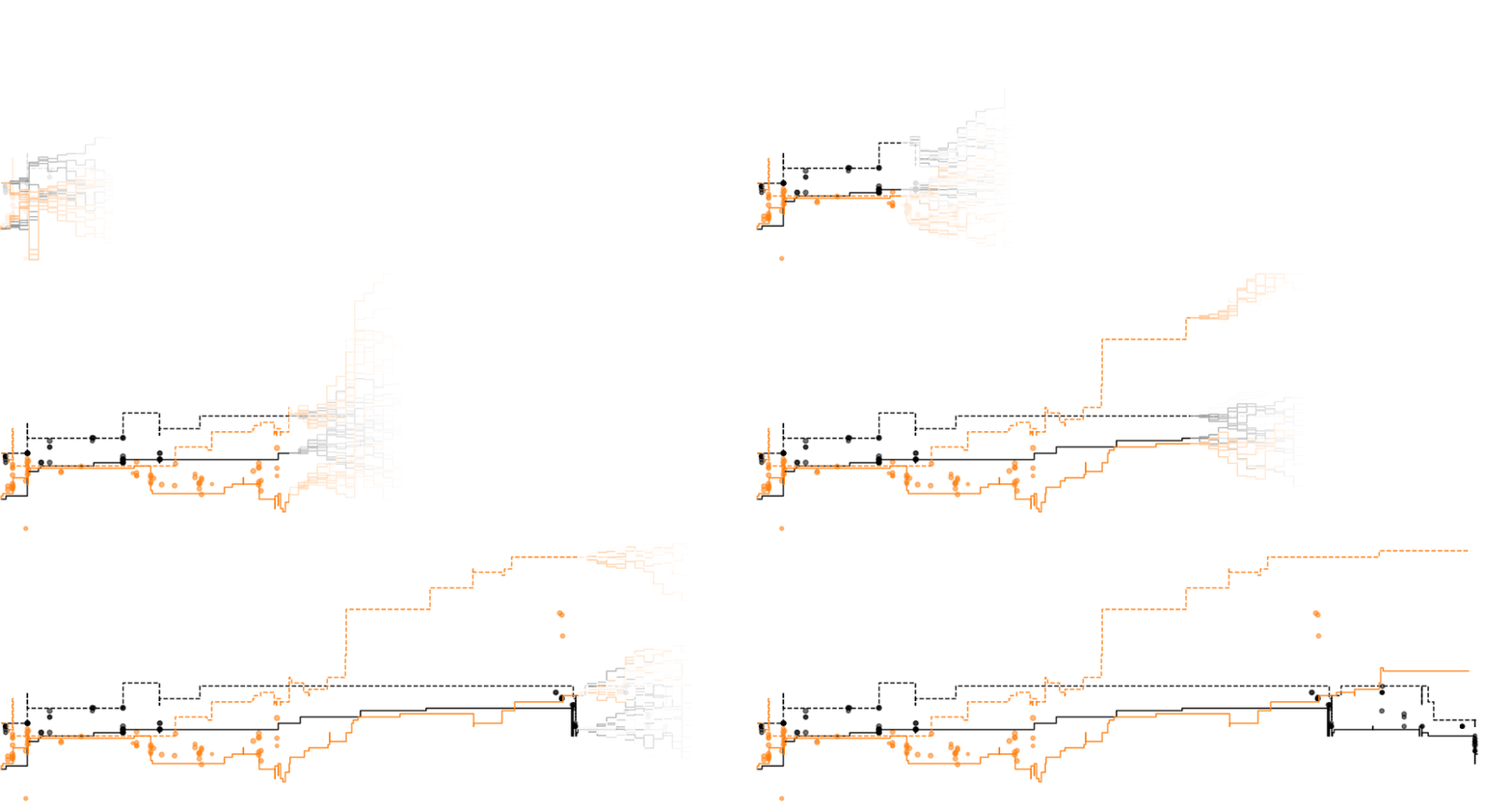
In quantitative finance, generative models are less common than predictive ones, but a summer intern project explored using autoregressive diffusion to synthesize market data events. The research intern, Kavish, built a model to generate not just price predictions but full order book events—including timing, order type, and price—by treating market data as a sequential, multimodal signal. Market data exhibits both discrete and continuous characteristics: order book updates are discrete actions, but price and timing have high cardinality or are inherently continuous, with spiky distributions like 'pennying' and bursty arrivals around whole-number times.
Kavish modeled four years of US equities data, using an encoder-diffuser architecture with a causally masked transformer encoder to produce latent embeddings. During training, an event-kind head predicted trade vs. BBO update, while a diffusion head generated continuous features like price and elapsed time. The model found that standard DDPM diverged, but flow matching performed better.
Fully continuous diffusion failed to capture the jagged nature of real market data, and attempts to handle point masses via smoothing or discretization clarified the path forward for a viable generative model of market data.
Source: Hacker News · Summarized by HeadlinesBriefing