
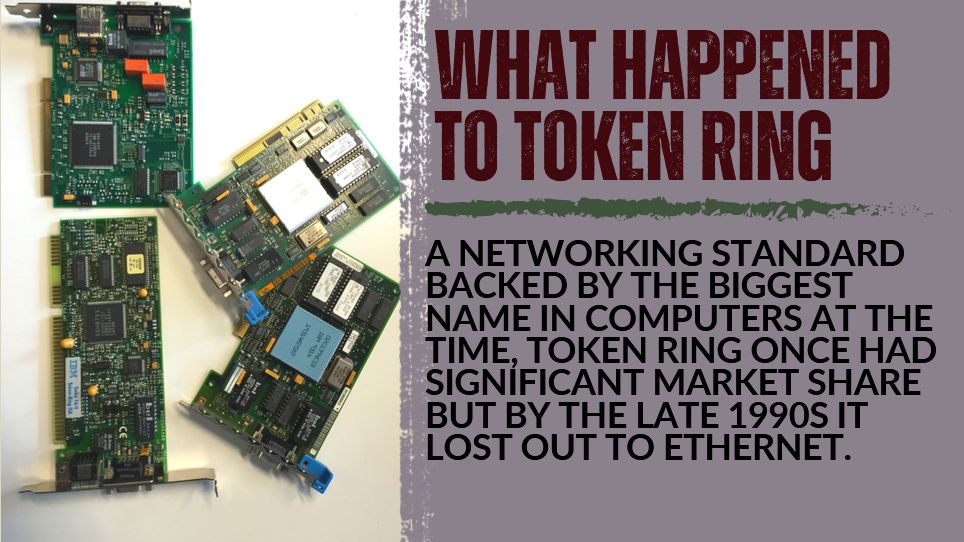
Token Ring is an obsolete networking technology that competed with Ethernet in the 1980s and 1990s. IBM first announced it on October 15, 1985. Today it is mostly a curiosity, the networking standard that lost. Still, when Token Ring equipment turns up, it can look enough like Ethernet to confuse people, and why it lost is worth studying.
Token Ring was a standard backed by IBM, while Ethernet was an open standard backed by DEC, 3Com and others. Companies like Intel and 3Com wanted a share of the Token Ring market even though it was an IBM technology. Token Ring gets a bad rap today, and that isn't necessarily fair. In operation, systems passed a token around the network, and only the holder could transmit. That meant no collisions, and Token Ring handled saturation far better than early Ethernet.
The main reason Ethernet won was cost. Once you bought everything you needed, Ethernet cost a third as much. Token Ring also had a serious weakness: it ran at fixed speeds, and all cards on the ring had to operate at the same speed. A single system set to the wrong speed could take down the whole network.
Ethernet also scaled to higher speeds first. It reached 100 megabits before Token Ring could respond, and Gigabit Ethernet arrived before 128 megabit Token Ring was released. At gigabit speeds, Token Ring's advantages were largely academic, since buses and disks had become the bigger bottlenecks.
Source: Hacker News · Summarized by HeadlinesBriefing