
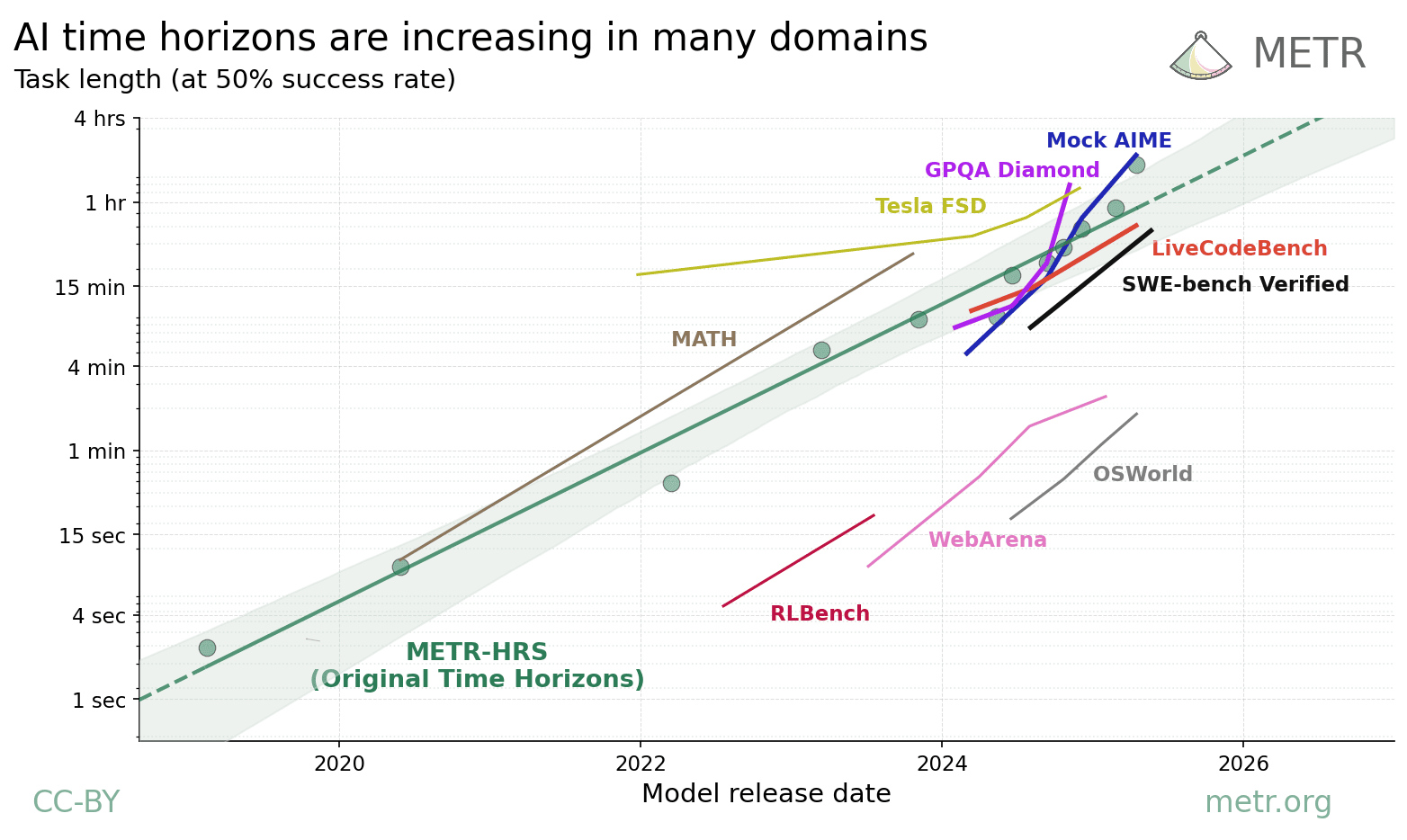
Coding agents are improving exponentially, with benchmarks saturating and models handling longer asynchronous tasks. As verification and simulation become the bottleneck, product development is being completely rewritten. The traditional sequential loop—Idea -> Product -> Design -> Engineering -> QA -> Production—spent most time on implementation, but now the cost/performance frontier of large language models is shifting.
With abundant code generation, there's a growing need to understand the story behind code and actual changes. The utility of code repositories is diminishing for many use cases. Consequently, roles like Design, Engineering, and Product are coalescing into one, with teams adopting a new unit of work: a verified change in product behavior, following the loop Intent -> Implementation -> Observed Result.
In this new loop, runtime signals—how software runs, looks, and performs—become paramount, not just the code. The repository can show file changes but not user experience issues like keyboard covering buttons or latency. Saving and aggregating this behavioral data across work holds immense value.
Companies like Revyl are building platforms to capture behavioral evidence for every product change, integrating with tools like Figma, Codex, Claude Code, and Cursor. In the next year, standards may emerge: pull requests include behavioral evidence, runtime signals become first-class context, and product, design, and engineering converge around outcomes. Product development is not dead—it's being fundamentally rewritten.
Source: Hacker News · Summarized by HeadlinesBriefing