
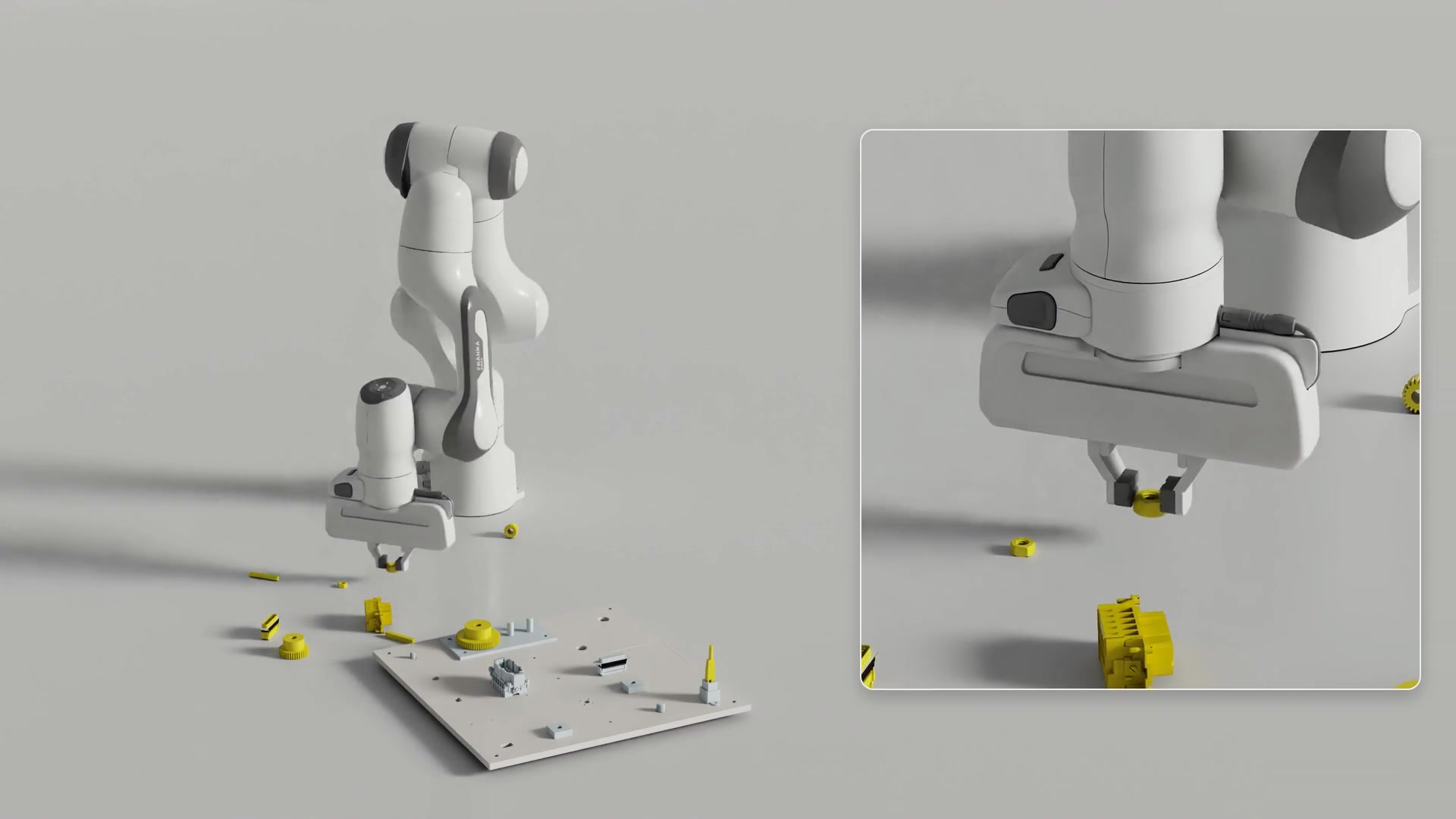
Assembling small parts is a demanding challenge for robots. The NIST Assembly Task Board #1 includes twenty tasks with components as small as 4 mm, and fitting a single part can require several changes of grasp and orientation. Tight clearances leave little margin for error, since a tilted nut can jam or cross-thread. When multiple parts are involved, the robot must also decide the order of operations, because an installed component may block the gripper's next move.
Rather than scripting every maneuver, researchers behind AlphaNIST take a different approach. Hand-coded instructions require anticipating how a robot should respond as contacts and obstructions change, and a two-finger gripper may need solutions very different from those a human hand would use. Instead, the robot receives a binary task reward for success and trains through vast amounts of diverse experience. This gives it room to discover solutions its designers never considered.
Training draws on heterogeneous assets and starting states. A single policy trains across twenty assemblies, beginning from loose parts, in-hand grasps, and partial assemblies cached in simulation. Near-complete starts let the robot practice finishing an assembly before it must solve the whole task. Success-guided sampling favors starting states the policy solves about half the time while still giving every state a chance, so practice shifts as the policy improves.
In experiments, one policy performs all twenty assembly tasks, with a single component assembled in each run. The work, described in an arXiv preprint by Octi Zhang and colleagues, is presented as an example of emergent assembly skills arising from binary task rewards alone.
Source: Hacker News · Summarized by HeadlinesBriefing