
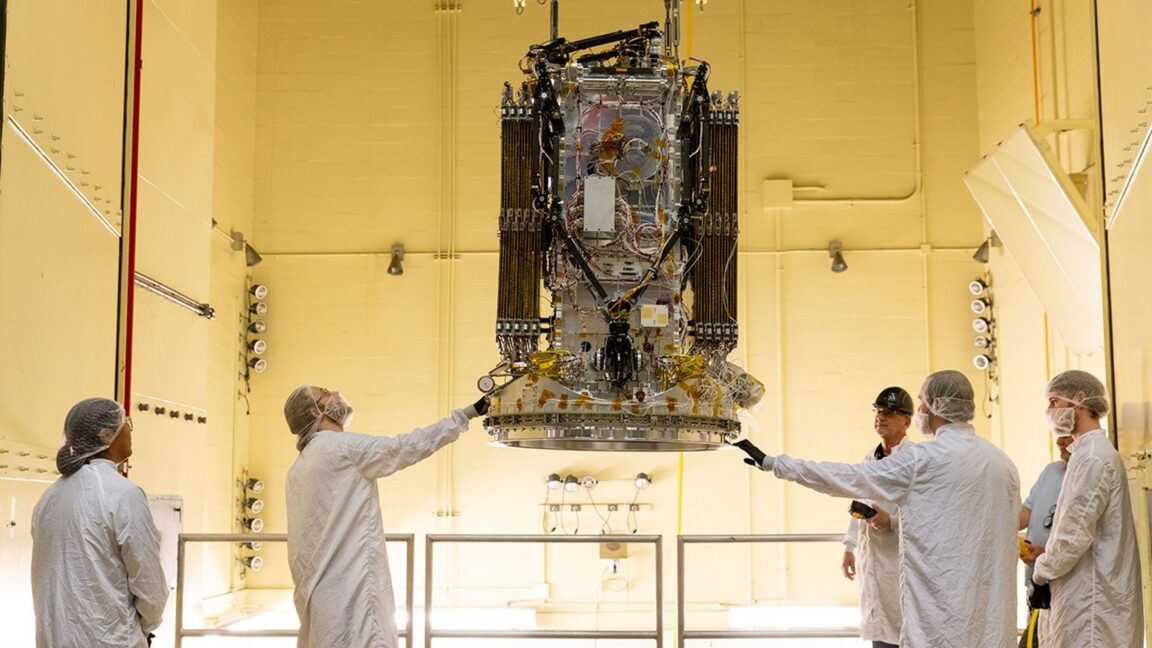
NASA faced a ticking clock in August when Swift’s orbit dropped to 225 mi, threatening a $500 million gamma‑ray mission. The agency issued a rapid request to three contractors, and Katalyst Space Technologies delivered a feasible plan within weeks. By September NASA awarded the startup a $30 million contract to build and launch a servicing satellite that would rendezvous with Swift using three robotic arms.
Swift, launched in 2004, lacks thrusters, so atmospheric drag has pulled it from its original 363 km altitude toward 300 km, where re‑entry becomes inevitable. Katalyst’s Link spacecraft, under half a ton, integrates xenon Hall‑effect thrusters, solar arrays and the capture arms. After thermal‑vacuum and vibration testing at Goddard, the bus shipped to Wallops for integration with Northrop Grumman’s air‑launched Pegasus XL.
The mission must launch by June 27 to reach Swift before it sinks below 300 km in October, a window that precludes a traditional launch from Cape Canaveral. Using the Pegasus air‑launch platform lets the small Link vehicle lift off over the Pacific, minimizing inclination changes. If successful, the rescue will extend Swift’s science life and demonstrate rapid‑turnaround satellite servicing for future low‑Earth‑orbit assets.
Source: Ars Technica · Summarized by HeadlinesBriefing