
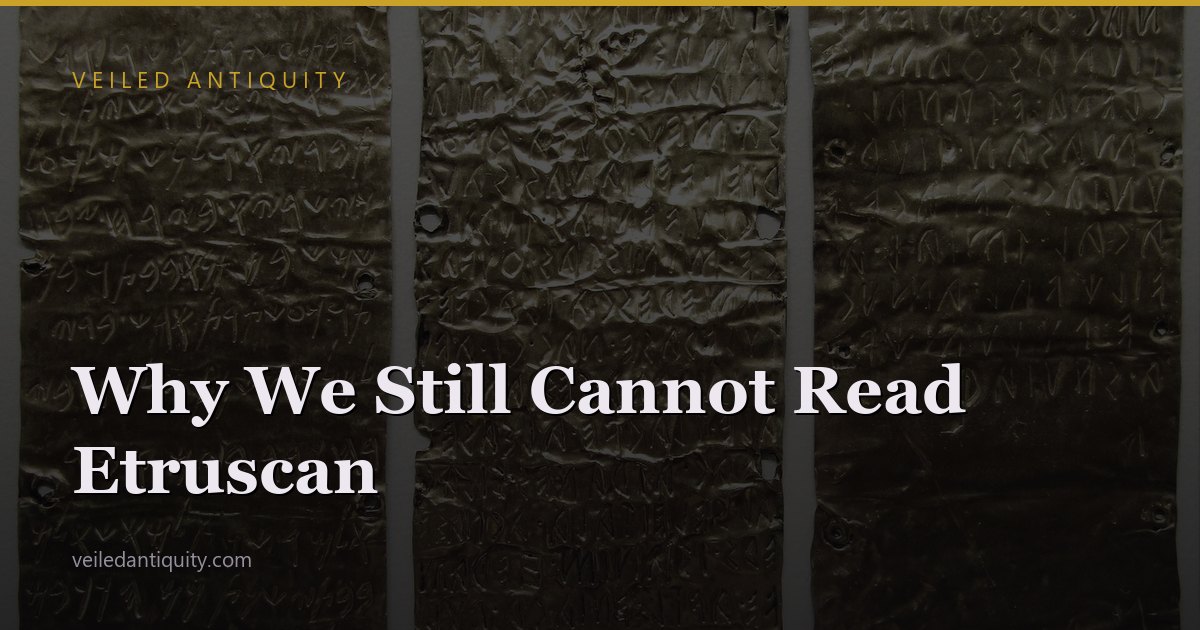
In 1964, excavators at Pyrgi uncovered three gold sheets: two in Etruscan, one in Phoenician, offering hope for a Rosetta Stone-like breakthrough. While the alphabet is Greek-derived and easily readable, allowing scholars to pronounce any inscription confidently, the language remains untranslatable due to a lack of vocabulary. Etruscan is not Indo-European, Semitic, or Uralic, though it may belong to the Tyrsenian family with Raetic and Lemnian—languages too poorly attested to aid lexical reconstruction.
Despite 13,000 surviving inscriptions, over 99% are short funerary or dedicatory formulae repeating the same forty words. Continuous prose exists in only four documents totaling roughly 2,000 words: the Liber Linteus (mummy wrapping), Tabula Capuana, Tabula Cortonensis, and Cippus Perusinus. These are administrative, legal, or liturgical—no narratives, histories, or literature survive.
The Pyrgi bilingual confirmed phonetics and grammar but could not unlock meaning without a lexical key. As a result, we can read Etruscan aloud but not understand it—a linguistic paradox where form is known but substance remains lost.
Source: Hacker News · Summarized by HeadlinesBriefing