
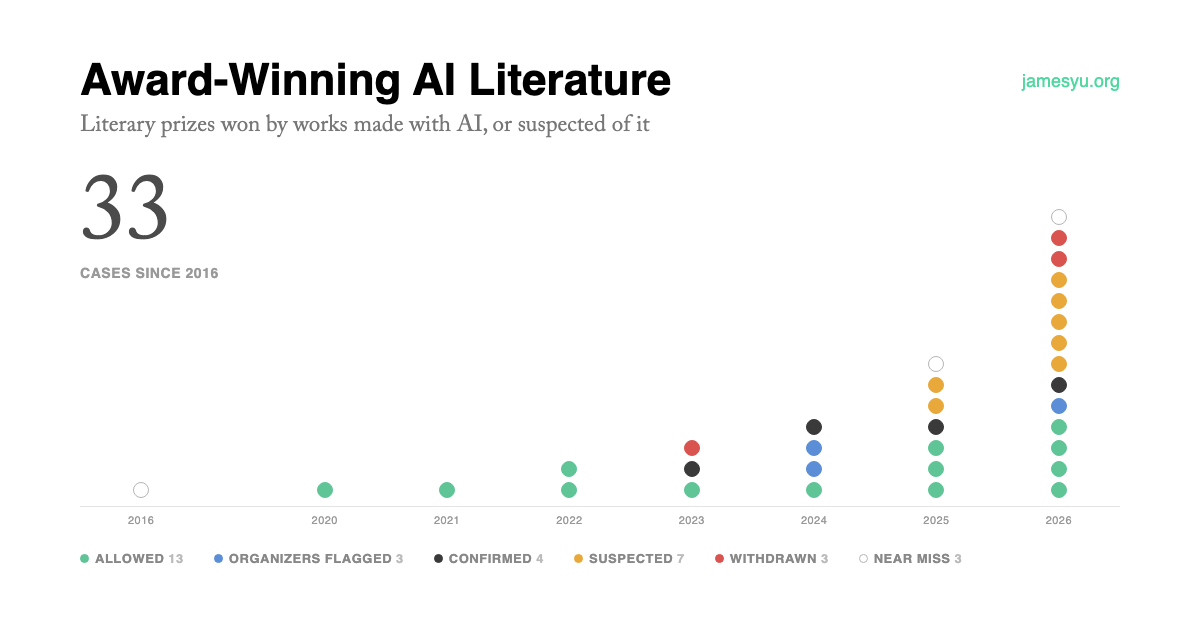
A growing list of literary awards has gone to works in which artificial intelligence was used, or suspected of being used, in the writing process. Some of these works were openly AI-assisted from the start, while others were classified as AI-assisted only by organizers who did not specify how much the technology contributed.
The Nikkei Hoshi Shinichi Literary Award is among the clearest examples. Kamome Ashizawa made 101 stories in three weeks with AI, and her winning story was mostly human-written with a little AI assistance. Toh Katagiri's "The Last Painter" was classified as AI-assisted without explanation, though a fellow finalist said Katagiri claimed every sentence was written personally. For the 13th Hoshi award, 2,107 entries were received, and organizers counted 491 as partly AI-created. Three of the four general-division winners had used AI somewhere in the process.
Other projects make AI central to their form. The Library of Nonhuman Books uses computer vision and language processing to find poetic combinations in physical books and publish new volumes. Výsledky vzniku was produced by training GPT-2 on 2,108 Slovak works, with the poems then curated and lightly edited by human creators. David Jhave Johnston's Re Rites openly calls itself "Human + A.I. poetry."
The list also includes works whose AI use was disclosed openly and welcomed by contest rules, such as Ruei-Jie Chang's "Stargazers," which used ChatGPT for its seed and required entrants to document their process. Together, these cases show how wide the range of AI involvement has become in prize-winning writing.
Source: Hacker News · Summarized by HeadlinesBriefing