
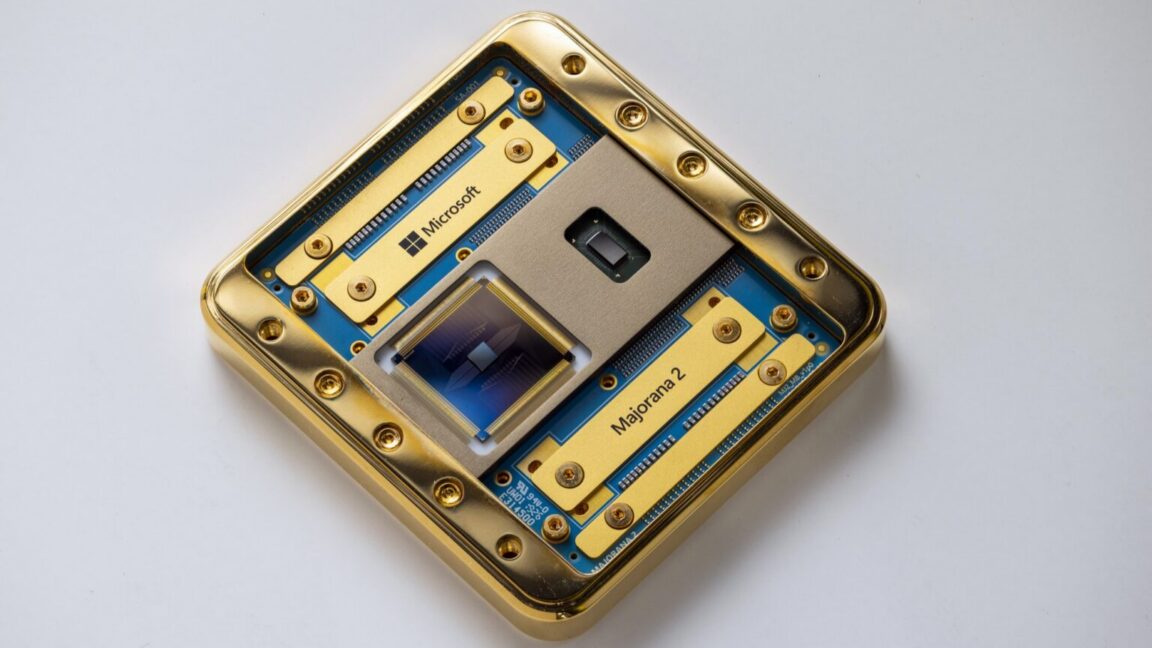
Microsoft released a materials update for its topological qubit platform, swapping aluminum for lead and adding tin to the semiconductor substrate. The change pushed parity‑state lifetimes from under 10 ms to occasional stretches beyond 20 seconds, a dramatic and significantly stability gain for the nanowire design. The company still must demonstrate controllable parity manipulation and scalable error‑correction linking.
Atom Computing, accessible via Azure Quantum, demonstrated a spare‑atom swapping technique that stabilizes logical qubits during error‑correction cycles. By inserting a pre‑cooled atom into a logical qubit, measurement‑induced heating no longer drives error rates upward, keeping them roughly constant across repeated checks. The method extended stable operation to about 90 rounds before an unrecoverable error occurred, potentially scaling.
EeroQ introduced a new chip version that couples a helium‑filled electron pool to an adjacent resonator, allowing the electron’s quantized motion to interact with the resonator’s two‑state system. This creates a viable qubit primitive, though computing hardware remains distant. Industry observers see these steps as essential groundwork for quantum cloud services.
Source: Ars Technica · Summarized by HeadlinesBriefing