
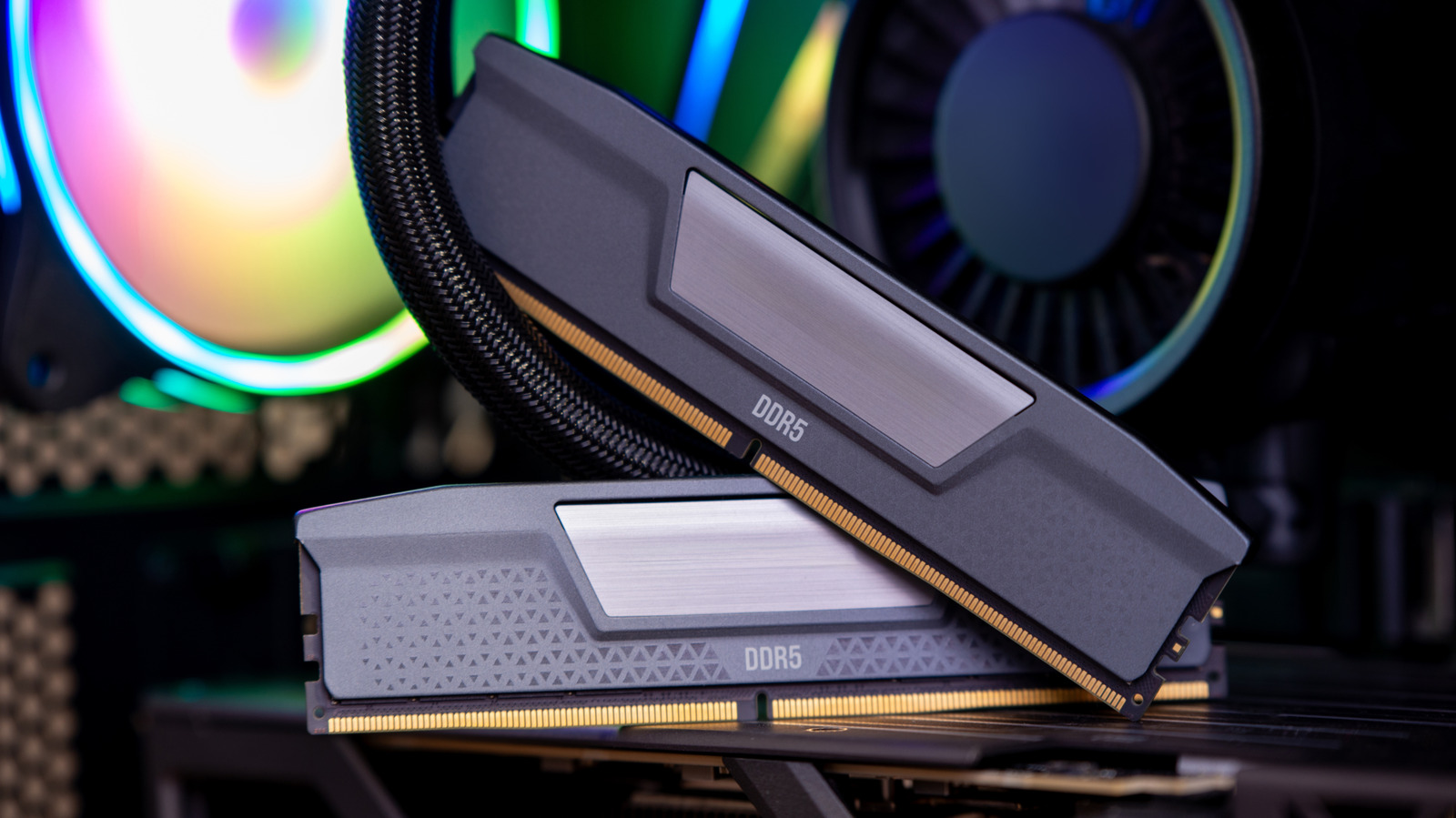
Any DDR5 kit will run your games. Moving up from the slowest to a mid-range kit might bag you a little bit of extra performance, but going any further will make almost no difference despite costing you up to hundreds of dollars more amid crazy RAM pricing. That's because there is no DDR5 speed that a particular game requires. Any game that runs on DDR5 will do so just fine on the DDR5-4800 kits at the low end of the market. At the higher end, DDR5-7200 and DDR5-8400 kits marginally improve frame rate during processor-bound gameplay.
All DDR5 kits are labeled with a four-digit number, like DDR5-6000 CL30. The number appended to DDR5-XXXX is the data rate in millions of transfers per second, while CLXX is the latency. Multiply the CL by 2000, divide by the data rate and you'll have the real figure in nanoseconds: 10 for a DDR5-6000 CL30 kit and nearly 17 for a "bargain" DDR5-4800 CL40 one. JEDEC's standard timings keep that number close to 14 nanoseconds all the way from DDR5-3200 to DDR5-8800.
AMD's spec sheet for a Ryzen 9000 processor lists DDR5-5600 as the supported memory speed. Almost every AMD build has a DDR5-6000 kit because Ryzen's memory controller can run at the same clock as the memory up to roughly 3,000 MHz. Intel's Core Ultra 200S desktop chips can take DDR5-6400 out of the box with CUDIMMs. Corsair says that DDR5 between 6400 and 7200 is best for 13th Gen Intel.
Is DDR5-4800 too slow? In short, no. DDR5-4800 is the 2021 launch speed for better efficiency and the baseline that every DDR5 processor is built to run. In Intel testing from Tom's Hardware, the lowest-scoring 32GB kit, a loose-timed DDR5-6400, finished about 4 percent behind the fastest across a range of heavy productivity work.
Source: Engadget · Summarized by HeadlinesBriefing