
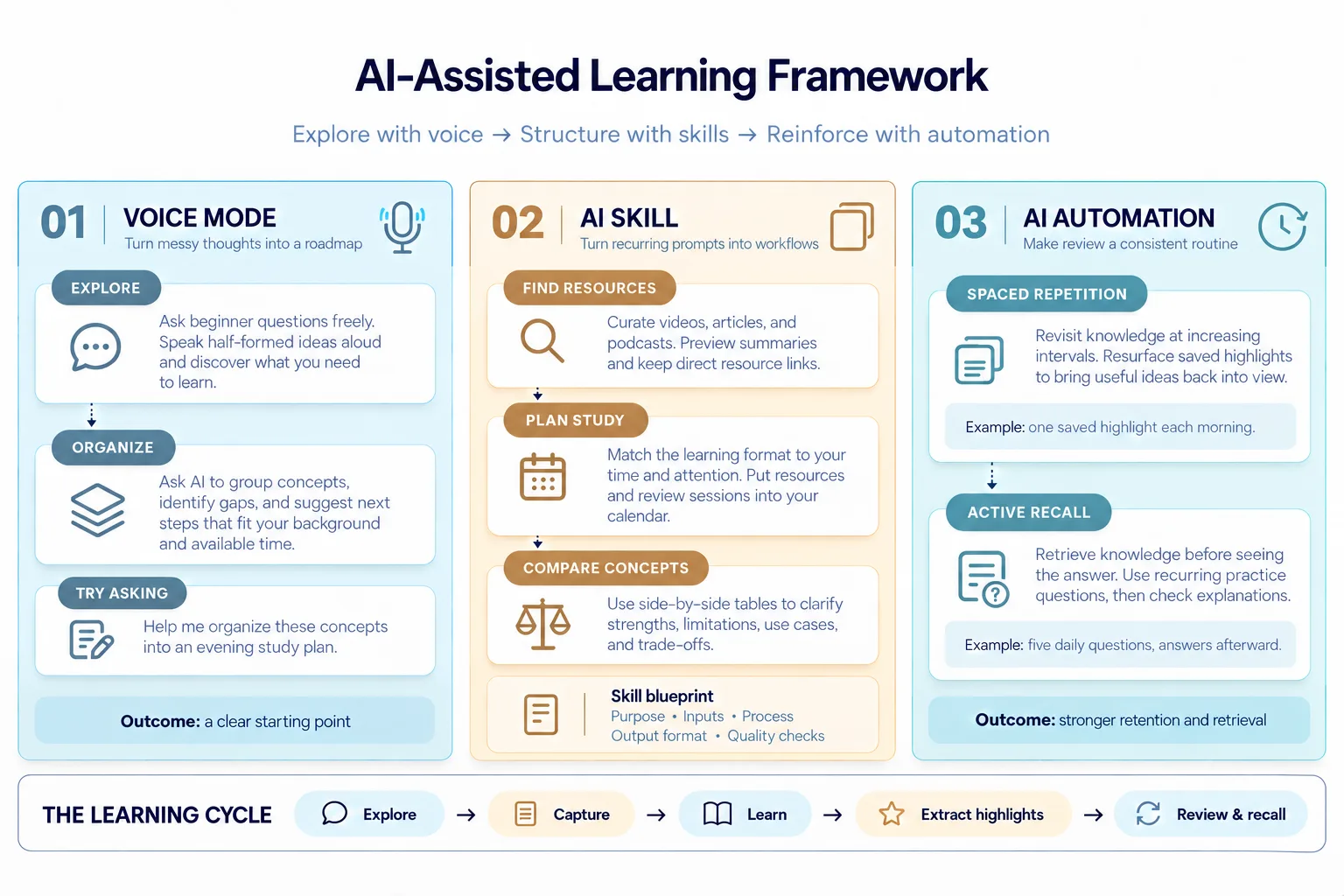
A practical framework for turning AI into a thinking partner. The post How I Use AI to Learn New Topics Faster: An AI-Assisted Learning Framework appeared first on Towards Data Science.
Whether AI is changing the way we work, think, and learn for better or worse remains an ongoing discussion, with one side arguing that AI is making us think less and another emphasizing that it dramatically reduces mundane work and boosts productivity. As AI continues to disrupt the entry-level work of data practitioners and developers, continuous learning and upskilling is essential. I believe we should leverage AI's capabilities and use it as a thinking partner to improve the effectiveness of learning, as if we were standing on the shoulders of giants. I’ll share three approaches to build an AI-assisted workflow that reduces friction in learning any new topics, including capturing ideas, finding resources, prioritizing attention, comparing similar concepts, and practicing spaced repetition and active recall. The goal is not to outsource learning and thinking to AI but to make it easier to start, repeat, and embed into everyday life.
1. Use AI Voice Mode for Exploration. Our learning process naturally progresses through four phases from being completely new to a knowledge domain till when knowledge becomes intuitive and difficult to explain: not knowing what you don’t know (unknown unknowns), knowing what you don’t know (known unknowns), knowing what you know (known knowns), not knowing what you know (unknown knowns). I found that chatting with AI using voice mode is a great entry point in this learning journey, particularly during the unknown unknowns stage, when exploration matters more than precision. Instead of navigating an ocean of unfamiliar concepts and incomplete ideas, we can verbalize our questions to organize our thinking while allowing AI to turn half-formed hypotheses into more structured pathways for exploration.
2. Use AI Skills for Repeatable Instructions. You may soon realize that many questions we ask AI follow a similar structure or have the same formatting requirements but are applied in different contexts.
Source: Towards Data Science · Summarized by HeadlinesBriefing