
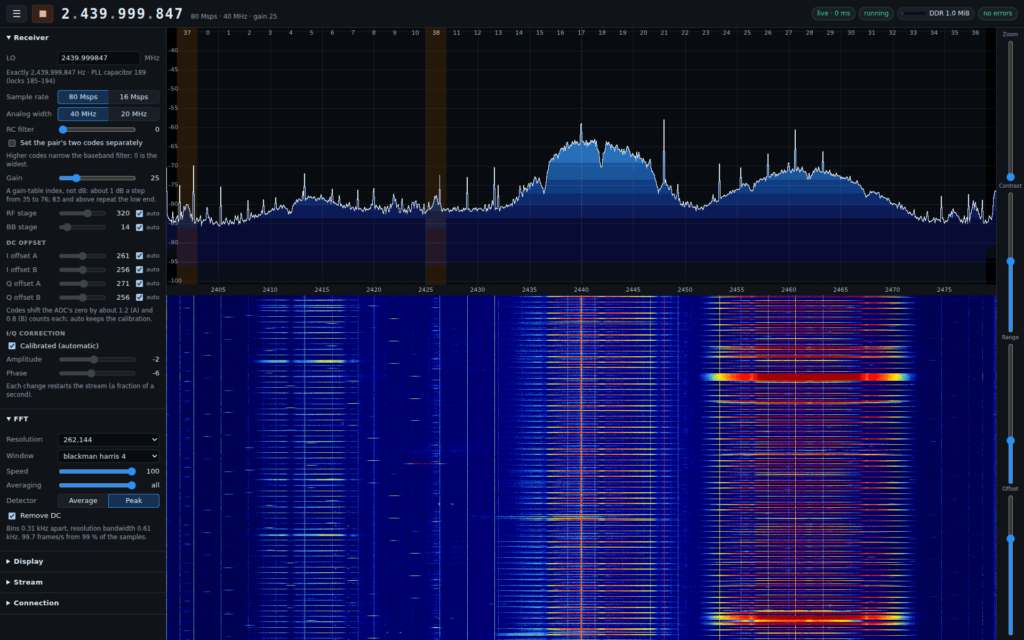
October 1, 2026 Back in 2025, we posted about ESPARGOS, a phased array of many patch antennas, each connected to an ESP32 Wi Fi microcontroller. ESPARGOS could be used to determine the direction of arrival for Wi Fi signals and create a live augmented reality heatmap. Recently, the ESPARGOS team has made an exciting discovery. They found that several ESP32 chips have an undocumented feature that lets the firmware bypass the fixed Wi Fi and Bluetooth functionality and instead capture raw IQ baseband samples. As a result, several ESP32 models can now be used as an internal SDR covering 2.2–2.7 GHz, plus 4.8–6.0 GHz on the ESP32-C5, with up to 80 MS/s sample rate and roughly 13–54 MHz of analog bandwidth, depending on the chip.
However, for use as a general-purpose PC-connected SDR, the output bandwidth is insufficient, so only snapshots of data can be exported to a PC. This means that the SDR will only work as a spectrum analyzer, and demodulating or decoding continuous radio data is not possible with just an ESP32. The exception is the new ESP32-S31, which can stream continuously at up to 16 MS/s over its Gigabit Ethernet interface, with a Soapy SDR driver for GNU Radio and gqrx coming soon.
Over on Reddit, user /u/h0m3us3r discovered the same feature and uploaded it to Git Hub on Sept 26, and recorded a video showing an ESP32-S3 working as an SDR with an FPGA used as a USB3 front end. Another project that seems to be using a somewhat similar finding is C5VRX, which was first uploaded to Git Hub on August 13. C5VRX uses an ESP32-C5 as a 5.8 GHz real-time FPV video receiver.
Source: Hacker News · Summarized by HeadlinesBriefing