
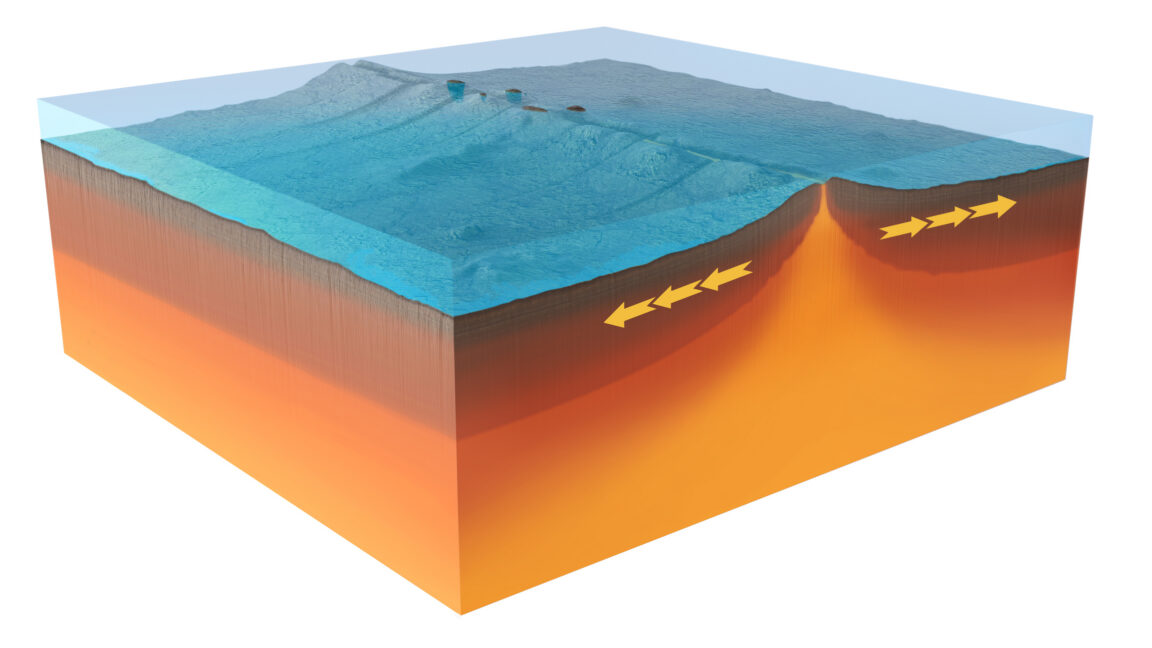
Scientists have captured unprecedented data on how mid-ocean ridges generate new crust. A French research team deployed underwater monitoring stations on the border of the Australian and Antarctic plates, near the Amsterdam–Saint Paul Plateau. Their equipment, installed in early 2024, recorded a significant spreading event that occurred over a short period, deviating from the gradual process previously understood.
The event involved the formation of dykes, which are intrusions of molten rock, and a notable subsidence of the seafloor in the central spreading region, reaching rates of 5 centimeters per minute. This was accompanied by a rise in water temperature, indicating magma interacting with seawater. Simultaneously, sensors detected the seafloor spreading apart by over a meter in some locations.
Subsequent 3D mapping revealed substantial seafloor changes, with some areas rising over 90 meters and an estimated 150 million cubic meters of new material deposited. Modeling suggests this rapid spreading resulted from the collapse of a deep magma sill, feeding a dyke and causing faults to extend by 2 to 4 meters. The total extension is equivalent to 38 years of average spreading. This suggests that mid-ocean spreading may occur in bursts, with periods of strain buildup followed by rapid crustal formation, and that some events happen without clear seismic detection, potentially altering our understanding of plate tectonics.
Source: Ars Technica · Summarized by HeadlinesBriefing