
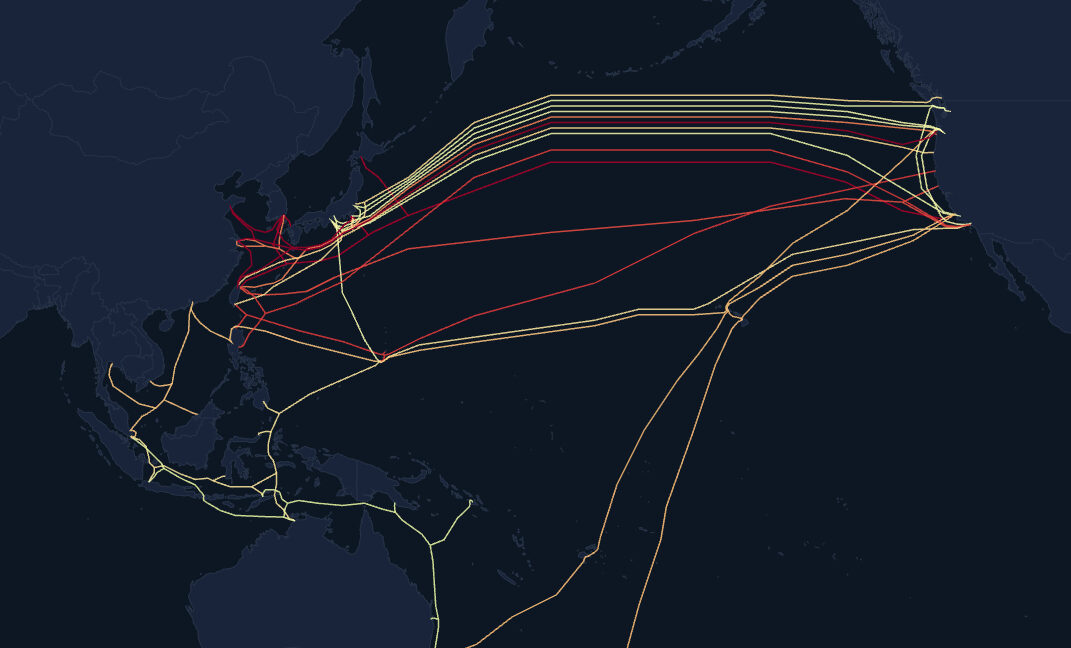
According to a recent risk assessment, the greatest threat to trans‑Pacific undersea cables lies around Taiwan, Japan, and the Philippines. The danger stems from China’s claim over Taiwan and the fact that many cables must traverse shallow waters with heavy shipping traffic.
The analysis identified 10 trans‑Pacific cables as most vulnerable, several still under development with substantial US ownership. Notable projects include the TPU cable backed by Google, the ORCA cable owned by Meta, and the E2A cable co‑owned by Verizon and firms from Japan, South Korea, and Taiwan. All three rank in the top 5 risk scores.
Experts warn that a single cable outage could overwhelm direct routing capacity between the United States, Taiwan, Japan and the Philippines, forcing data onto slower paths. A coordinated disruption of multiple cables — especially during a Taiwan‑related crisis — could drastically cut headroom and overload the trans‑Pacific network, affecting internet, cloud services and financial trading.
The report also highlights growing dual‑use capabilities, such as submarine drones and cable‑cutting tools, and notes that China has deployed research vessels equipped with seabed‑mapping tech near key cables, a trend documented by the Center for Strategic and International Studies in a October 2026 study.
Source: Ars Technica · Summarized by HeadlinesBriefing