
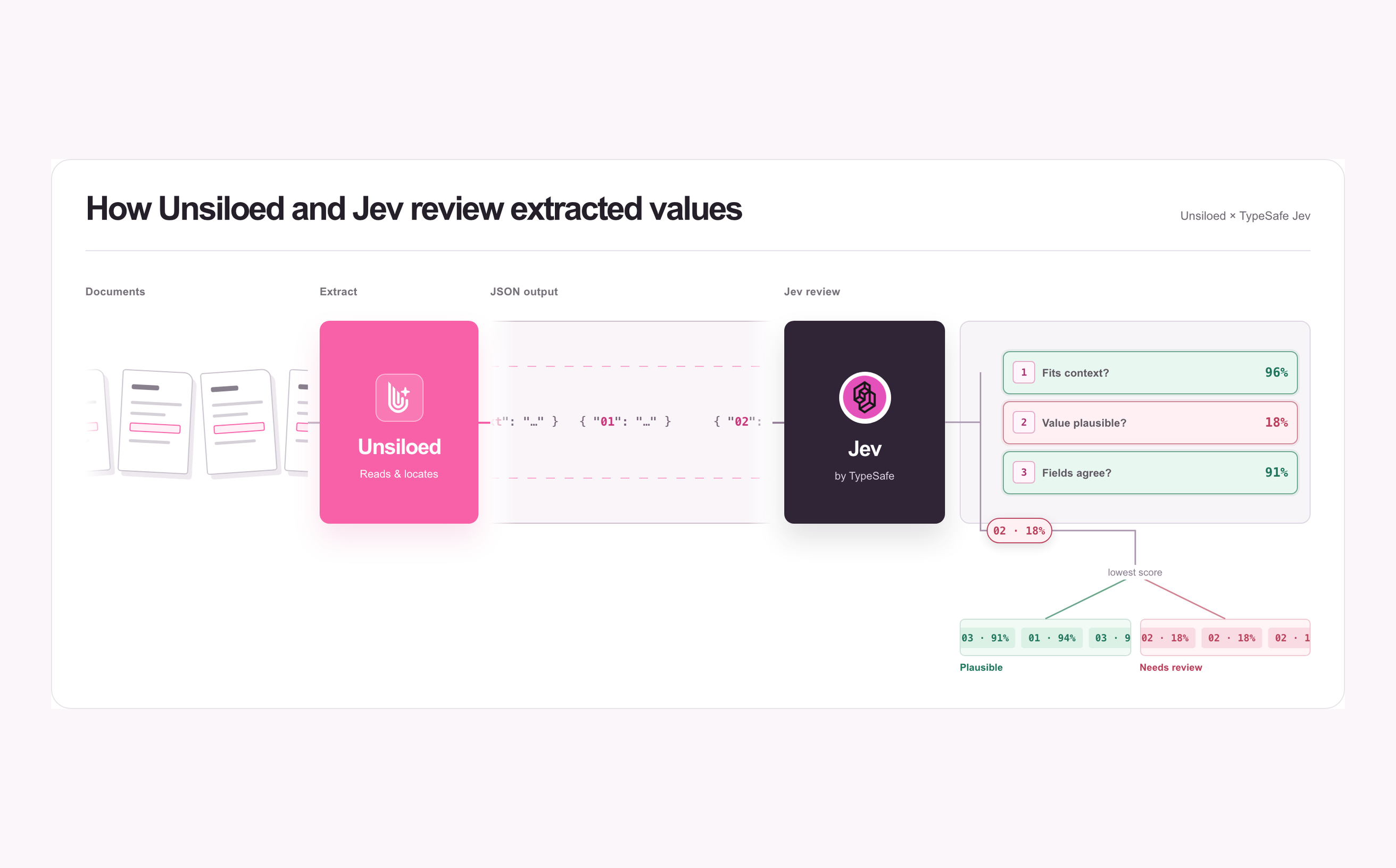
An extraction pipeline can read a value correctly and still pass bad data downstream. A clearly printed extra zero can survive excellent optical character recognition (OCR). Combining Unsiloed and Type Safe's Jev helps check for OCR failures and general mistakes in a document. Unsiloed extracts structured fields and locates them on the page, while Jev judges the extracted information against focused questions. Together, these results help decide which fields need review.
A Jev request separates the information it considers (state) from the decisions it makes (questions). Each question tells Jev what to check and which answer type to return. The Noul type returns the probability that a statement is true. A value of 0.04 means a 4% probability of yes, a strong no; it does not mean Jev is 4% confident. Values near either end indicate a clear direction, while values near the middle deserve caution. Choice and Score types return a distribution and a confidence value.
Unsiloed preserves what is printed and provides confidence scores, including extraction_score and grounding_score, both ranging from zero to one. Each extracted field also carries a citation with its page and bounding box, so reviewers can locate it on the original page. Each medication row receives an ID, such as row-5, so Jev's answers can be matched back to the same row.
Jev receives the extracted values and context but not the image or Unsiloed scores. The workflow asks one Noul question per row: is this dose and frequency plausible for this medicine? All rows share one request, and each question is evaluated independently, allowing the pipeline to route ambiguous or implausible rows for human review.
Source: Hacker News · Summarized by HeadlinesBriefing