
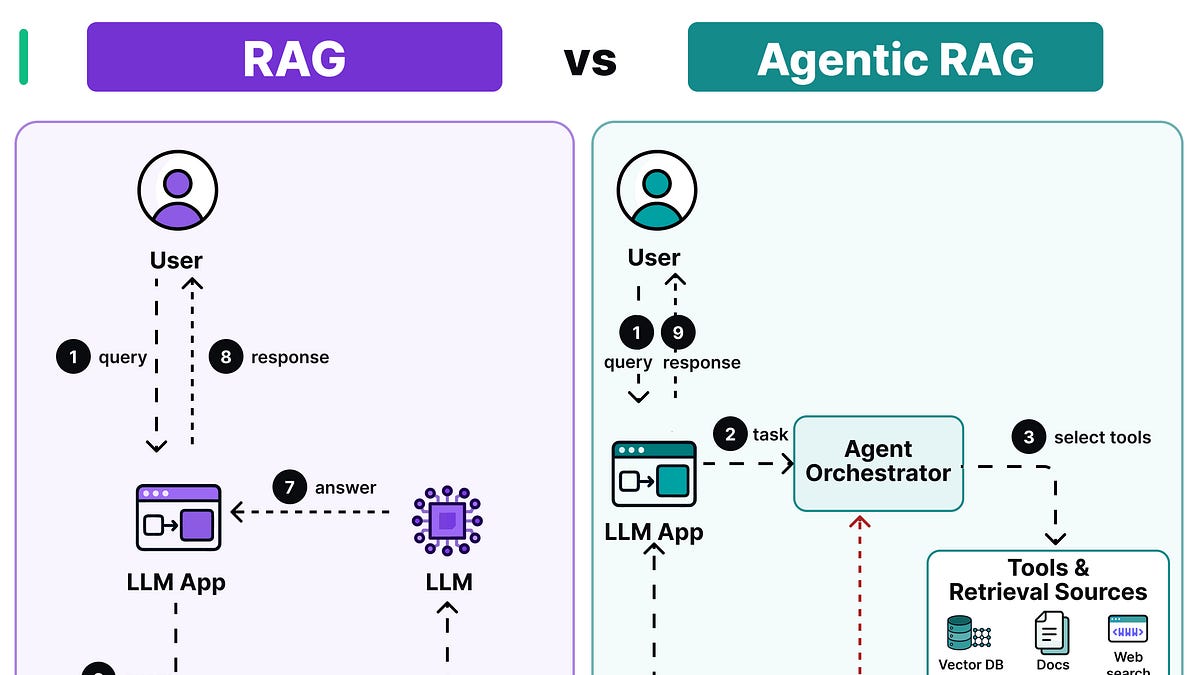
RAG (Retrieval-Augmented Generation) combines information retrieval with an LLM to generate answers by fetching relevant context from a knowledge base once. The quality depends heavily on the accuracy of that single retrieval. In contrast, Agentic RAG uses an intelligent agent that dynamically selects tools—like APIs, databases, or web searches—and iteratively fetches and evaluates evidence until it has sufficient context. This adaptive loop allows it to refine searches, switch tools, and verify information before generating a final answer, making it more robust for complex, multi-step queries.
Open source remains foundational, with companies like Sentry contributing $1M to support maintainers via the Open Source Pledge, which has raised $8.4M from 37 members. Meanwhile, OAuth 2.0 enables secure app access without sharing passwords—Slack requests calendar access via Google’s authorization server, receiving an access token. OIDC, layered atop OAuth, adds authentication by returning an id_token (JWT) to verify user identity. In Linux, the root directory "/" contains key folders: "boot" for kernel files, "dev" for devices, "bin" and "sbin" for essential commands, "usr" for software, "etc" for configs, "var" for logs, and "mnt" for temporary mounts like USB drives.
Source: ByteByteGo · Summarized by HeadlinesBriefing