
Your team connected Slack, Jira and GitHub over MCP, and engineers still spend their time steering agents to the right answer. This article looks at why: connectors fetch from one tool at a time, so every agent stitches the pieces together itself, trusts the first doc that looks right, and adds a search to your token bill each time. Read what changes when a context engine sits on top of your connectors: the same coding task finished 83% faster at 48% lower cost.
Anthropic has recently reached a point where coding isn't the bottleneck for them. Claude is able to do a lot of heavy lifting. It can iterate on research loops.
Or optimize complex programs. Or even build new services from scratch. However, the main problem Anthropic faces is that the infrastructure they have around writing code is not able to keep up with the amount of code being generated by its agents.
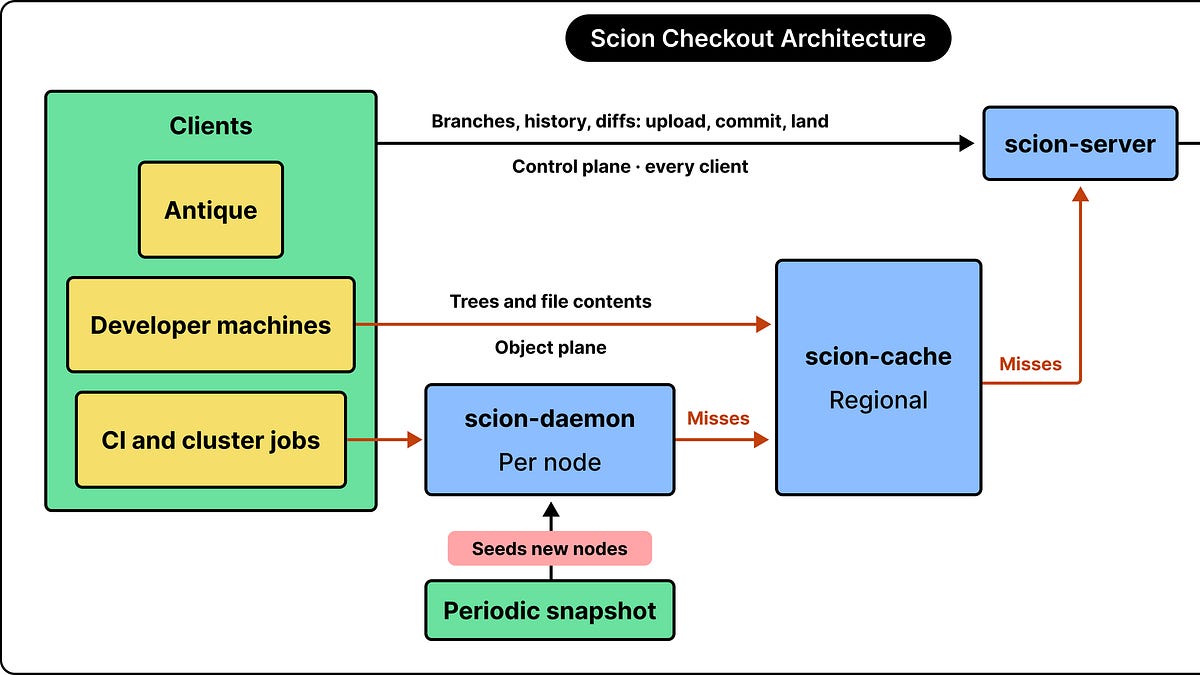
Activities like downloading repositories, preparing workspaces, and recording changes are becoming major bottlenecks. To solve this problem, the Anthropic engineering team built Scion. You can think of Scion as a source control system that has been designed around a huge repository and clients that are almost always online.
Here's what we will cover: How source control works, Anthropic's problem with source control, Why Git couldn't solve the problem, How Scion works, How changes are handled in Scion, How Scion caches data, How Anthropic scales Scion. A software project is made up of files that change continuously. Developers add features.
They correct mistakes and update dependencies. They also sometimes need to recover an earlier version. A source control system records all these changes and lets multiple developers work on the same codebase.
A repository contains the project's versioned information. Next, you have a commit that denotes a specific version along with other details such as the author, a description, and a history of the earlier commits. A branch is used to demarcate a line of development.
For example, your main branch signifies the line of code into which you integrate all the reviewed and approved changes. Different developers can work on different branches and combine their code through a merge process. The files present on a developer's machine are known as the working copy.
A checkout process prepares those files for a specific version. Lastly, you also have automated systems that rely on source control. Continuous integration (CI) runs processes such as compilation, testing, and other checks when code changes.
Each job may need a workspace that contains the appropriate version of the code. Coding agents and research jobs need similar environments. Anthropic stores a large amount of its code in a monorepo.
You can think of a monorepo as a shared repository that contains multiple projects and components. This way, code that is related can share a common history. But it also means that many separate activities might depend on the same source control infrastructure.
But a large repository is only a part of the story. Anthropic's problem is much deeper. They report that merged changes have grown from roughly 2500 per day in May 2026 to more than 30000 per day by September.
Meanwhile, the size of its main branch's history is close to 100 GB. Even a compressed working copy goes beyond 25 GB. The CI system is doing approximately 25 million checkouts per day.
This number is before counting developer environments, agent sandboxes, and research jobs. Ultimately, your infrastructure wo.
Source: ByteByteGo · Summarized by HeadlinesBriefing