
Your app, live in seconds, for free. Railway’s push-button compute, storage, and networking is available immediately upon sign-up. Humans and agents alike operate on one vertically integrated system including hardware, software, and a prompt-to-production experience.
This week’s system design refresher covers AI terms from GPT-2 to GPT-6. GPT-2 (2019) was a 1.5B-parameter prototype using next-token prediction. GPT-3 (2020) scaled to 175B parameters, enabling in-context learning. GPT-4 (2023) added multimodality and 32K token context via RLHF fine-tuning. GPT-5 (2025) introduced built-in reasoning with 400K token context windows. GPT-6 (2026) features a 1.05M token window, async tool calling, and mid-turn steering.
Interviewers test fundamentals across two buckets: Traditional AI covers pre-neural network ML topics, while Modern AI focuses on transformers, RAG, and post-training concepts. Candidates should explain how these systems work, their failure points, and trade-offs.
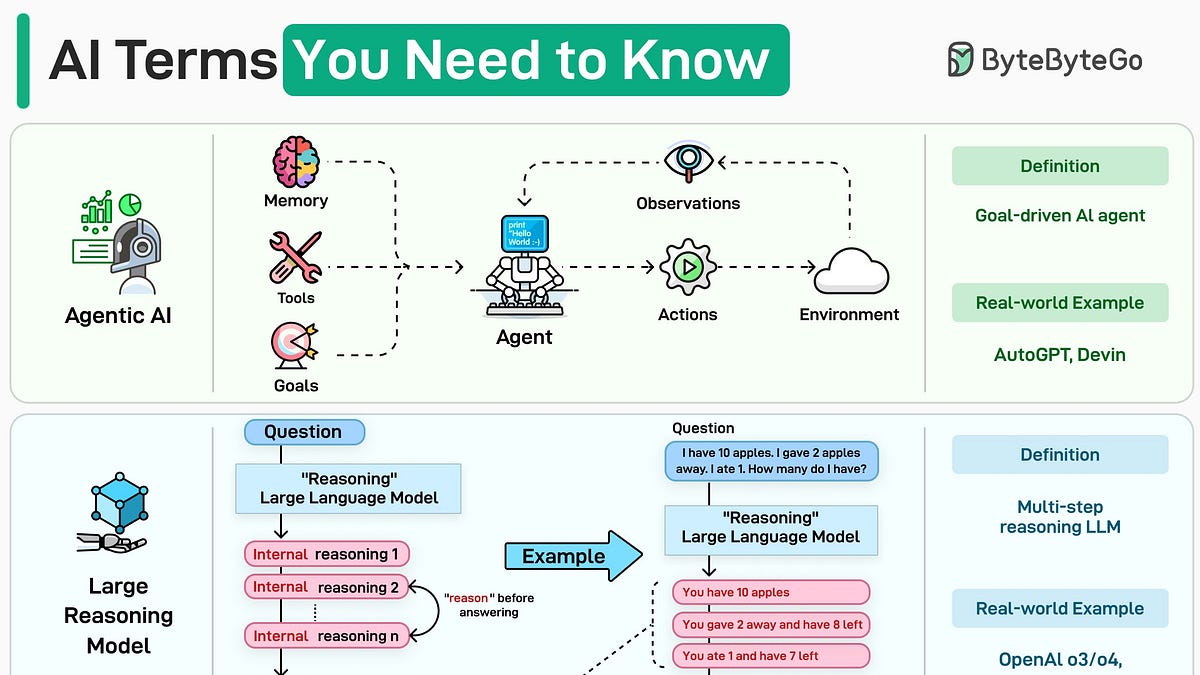
Key concepts include Large Reasoning Models that break problems into smaller steps, Vector Databases storing numerical representations of data meaning, Retrieval Augmented Generation (RAG) connecting models to external information, and the Model Context Protocol (MCP) standardizing AI tool access.
Source: ByteByteGo · Summarized by HeadlinesBriefing