
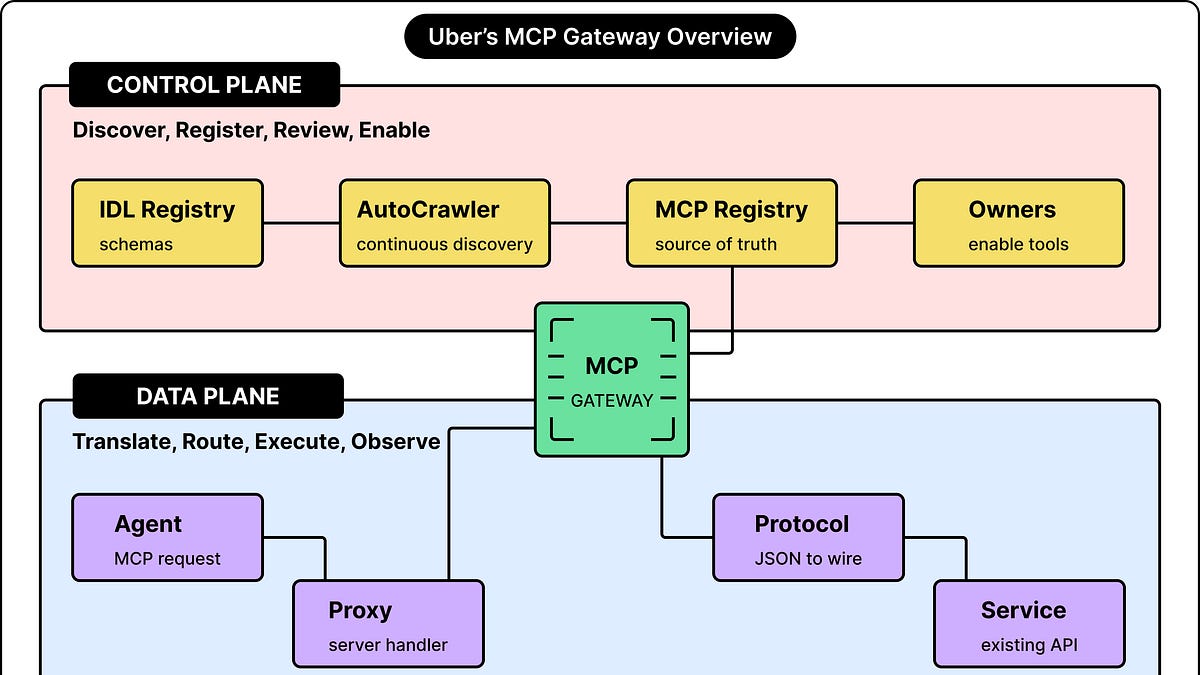
Off-the-shelf large language models can explain errors or write generic queries, but they cannot answer questions about a company's specific internal systems without access to them. That access is provided through tools, which are defined operations an AI application can execute, such as searching logs, retrieving incident details, or checking deployment status. The model selects a tool, the application runs it, and the result returns to the model.
In enterprise environments, the number of tools can grow quickly, creating a management problem. Uber's engineering team addressed this by building the MCP Gateway, a shared platform that lets different AI agents discover which tools are available and use them. MCP, or Model Context Protocol, provides a standard way for AI applications to find and communicate with external capabilities.
Uber's design relies on three core MCP concepts. The MCP client sits inside an AI application and handles requests such as listing tools or calling them. The MCP server exposes capabilities and accepts those requests. The MCP tool is the individual operation a server provides, and one server can offer many tools.
The gateway also handles how tools are discovered and how access is controlled, ensuring agents only use the capabilities they are permitted to reach. This central layer lets teams add and manage tools without rebuilding integrations for each agent.
Source: ByteByteGo · Summarized by HeadlinesBriefing