
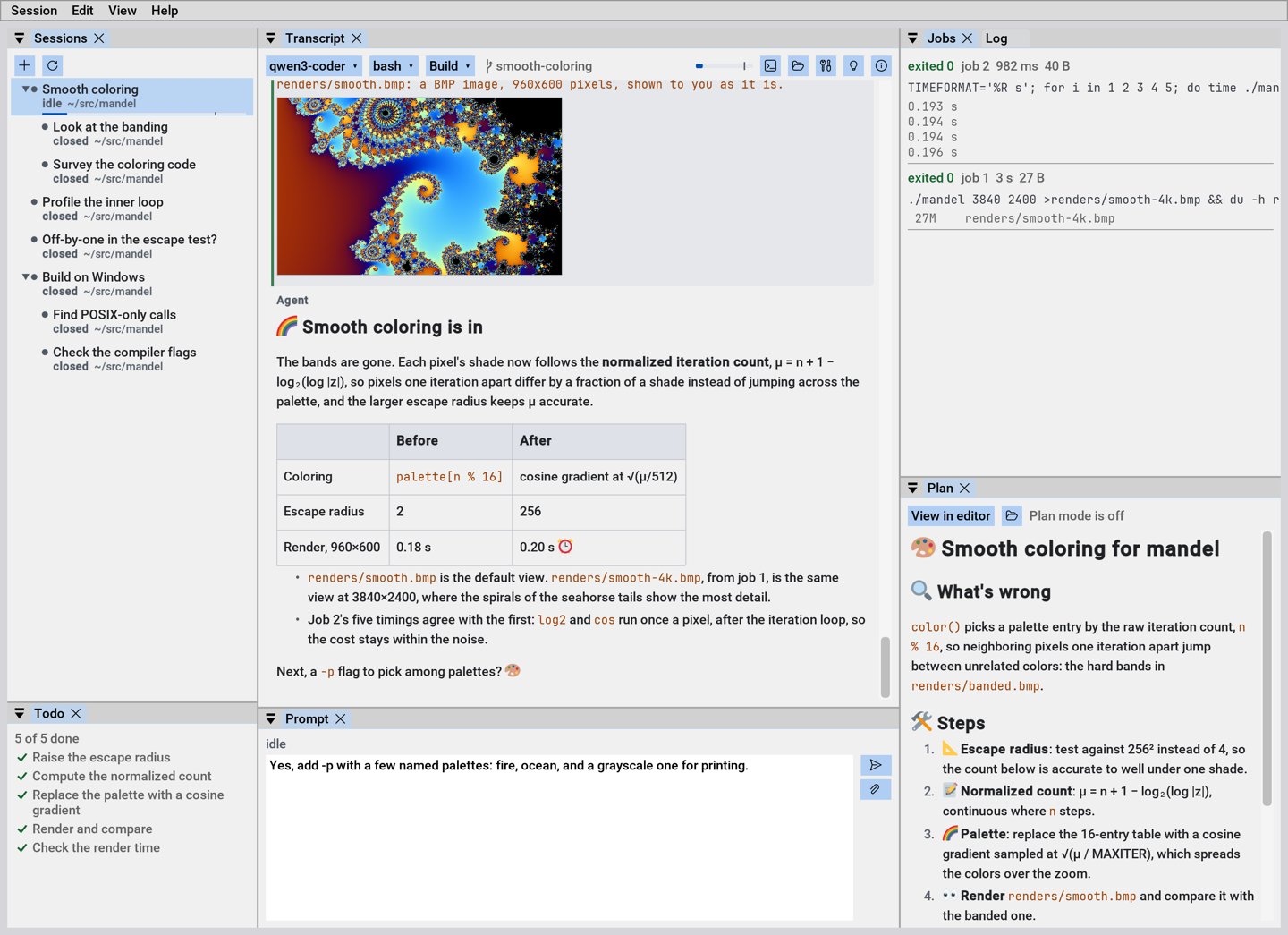
I’ve been fascinated with local LLMs for a couple of years. Better open weight models can now handle simpler programming tasks on regular hardware. This requires a coding harness, but offerings this year have been disappointing, often built with web stacks and consuming enormous memory.
At its core, a coding harness is essentially curl glued to popen(), which should not require gigabytes of RAM. So I built my own: Prospero. It is written in a C++ style with a Dear ImGui docking interface and uses around two orders of magnitude fewer resources than other harnesses without sacrificing features.
Dark mode is supported. Prospero comes with no model providers built-in; users must supply their own, such as llama.cpp, a workplace on-premise model, Open Router, Anthropic API, or OpenAI API. For those unfamiliar, a coding harness extends the chat interface, allowing an AI to "talk" to tools offered by the harness.
Tools reply with their outputs, such as reading or writing files or running shell commands. An AI will go from tool call to tool call on its own, looping on the results, such an AI is called an agent. Occasionally the AI will send a message to inform you of progress or ask a question.
Some harnesses, including Prospero, allow agents to spawn subagents to work in parallel or keep their context clean. Given SSH access or WSL, Prospero can deploy a headless copy to other hosts so agents can operate on those systems. The Professional Edition embeds engines for x86/x86-64 and ARM64 on macOS, Windows, and Linux.
The Windows x86 engine even works on Windows XP and can play solitaire and Minesweeper. This is because Prospero is one of the few harnesses with desktop control capabilities. If your model supports vision, it can "see" your desktop and interact with it to test and debug GUI applications live without a specialized MCP assist.
This headless engine is why no TUI is necessary. The harness engine runs on the headless system, and the UI runs on your desktop or laptop. It can run fully independently of the GUI and is re-attachable later.
Because Prospero is so lean, it may be the only harness that can drive a fuzz campaign on a headless system without the Linux OOM killer targeting the harness rather than the fuzz target. An agent can fix discovered bugs on the fly and keep the campaign going. Configuration lives at ~/.config/prospero/prospero.ini, easy to edit without JSON.
INI files can include each other, naming file system paths or URLs. Includes by URL are restricted with a hard rule against anything appearing in shell commands.
Source: Hacker News · Summarized by HeadlinesBriefing