
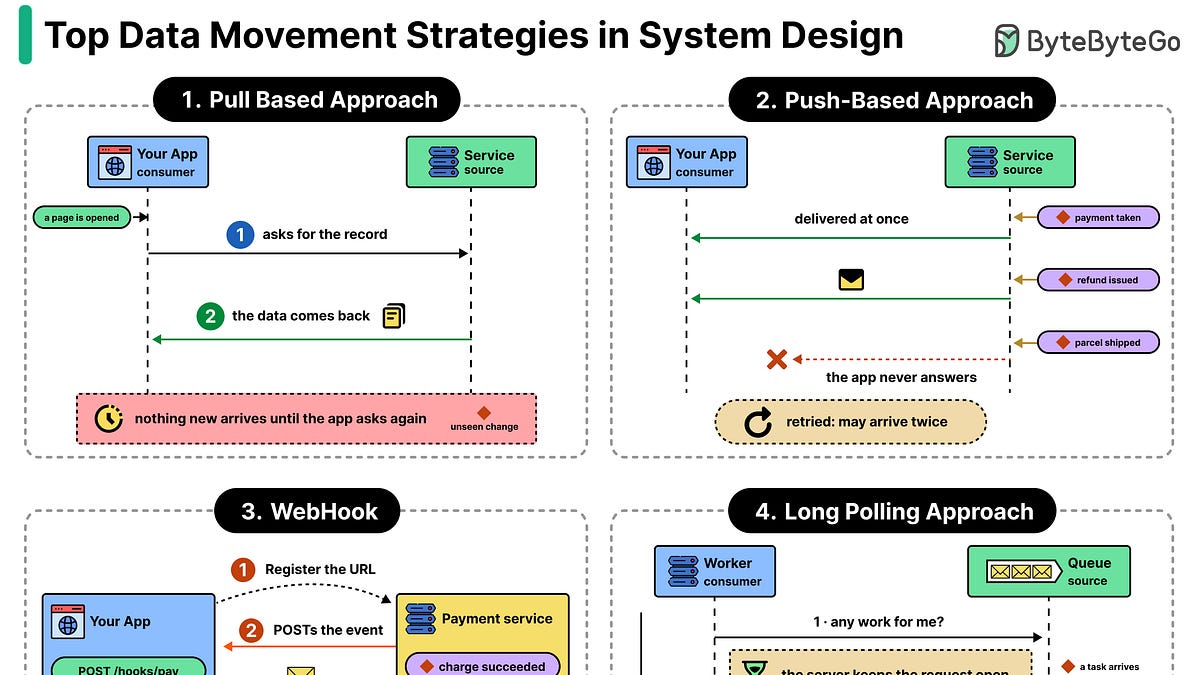
Software systems rarely keep information in one place permanently. When a user requests data, it travels from the application to a server, where a database may store the necessary records. Other components often need to be aware of changes to function correctly.
Managing this data movement is essential to connect separate activities into a coherent system. This involves deciding when and how information should travel within a system and externally. Several strategies handle this movement, each offering distinct benefits.
The choice of strategy depends on the specific needs of the application. Key approaches include the pull approach, where a consumer actively requests data; the polling approach, which checks for updates at set intervals; and the push approach, where the server sends data automatically. Long polling keeps a connection open until data arrives.
For real-time requirements, Server-Sent Events (SSE) and WebSockets enable continuous communication. Message queues decouple producers and consumers, while Change Data Capture (CDC) tracks database changes efficiently. Selecting the right strategy requires balancing latency, resource usage, and system complexity to ensure reliable data flow.
Source: ByteByteGo · Summarized by HeadlinesBriefing