
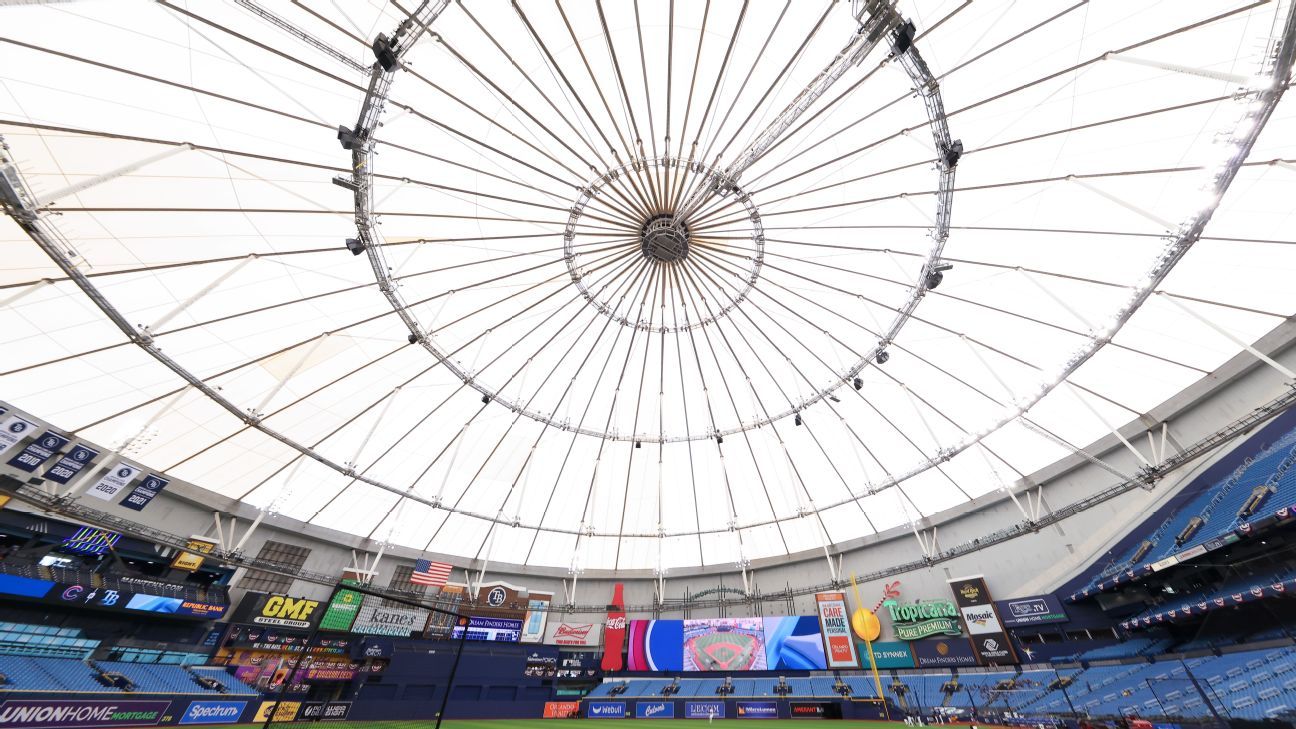
This year's World Series features two teams that share a unique trait: both the Tampa Bay Rays and Milwaukee Brewers play in stadiums with roofs. Milwaukee's American Family Field has a retractable roof, while Tampa Bay's Tropicana Field has a permanent one. Both venues have produced a potential quirk called a "roofball," when a ball strikes the roof or its structure and falls back into play.
The term may be a bit overblown, since the two playoff roof hits in quick succession were more coincidental than predictive. Still, it gives fans a fun angle on an already compelling matchup. In the ninth inning of Game 1 of the Brewers' divisional round series against the San Diego Padres, a fly ball by Ty France hit a roof cable at American Family Field and fell back for an out. Days later, in Game 2 of the Rays' series against the New York Yankees, a pop fly by Spencer Jones ricocheted off a catwalk at Tropicana Field for another out.
The stadiums differ significantly. American Family Field's roof spans 600 feet, covers 10.5 acres, sits 330 feet above the field at its apex and weighs 12,000 tons. Tropicana Field's roof stands 225 feet above the infield at its peak and is made of 24 panels weighing 5,000 pounds each. It was repaired ahead of the 2026 season after damage from Hurricanes Helene and Milton.
Roofball moments are rare, but they are more common in Tampa. France's hit was only the third collision in American Family Field's history. The most notable earlier one came in 2008, when Jayson Werth's fly ball struck the roof truss, and Craig Counsell made a diving catch for the out. At Tropicana Field, collisions are more frequent, and in 2016 Miguel Sano became the first player to hit the roof itself rather than a catwalk.
Source: ESPN MLB · Summarized by HeadlinesBriefing