
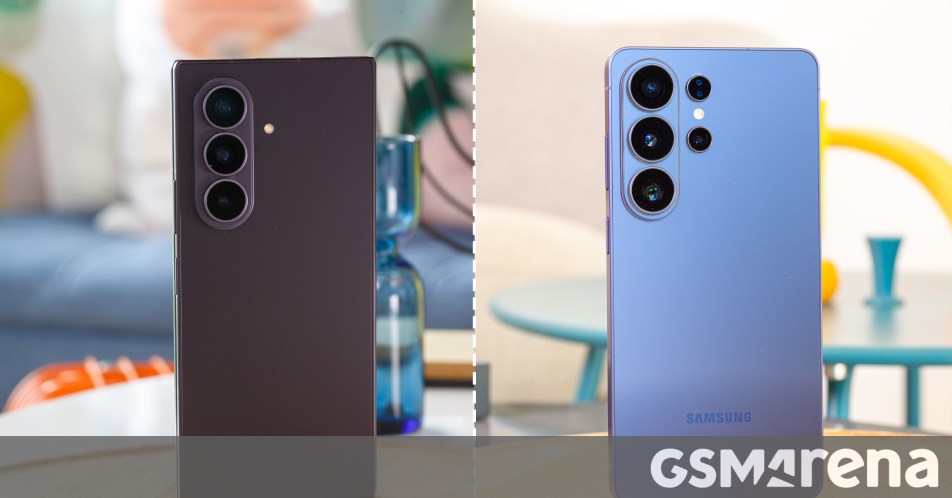
So, you're eyeing a new Samsung flagship and, if money is no object, the new Galaxy Z Fold8 Ultra might be on your shortlist. Then again, perhaps you're not entirely convinced that you actually need a foldable in your life. Wouldn't the simpler, more conventional Galaxy S26 Ultra make more sense? Granted, this is a fairly specific dilemma and probably not an especially common one. Still, let's put the two side by side and see where each one has the upper hand.
Size comparison
Despite their vastly different form factors, the two phones actually have a surprisingly similar footprint. If anything, that's a strong endorsement of how far modern foldable design has come. Even with vastly more total screen area, the Z Fold8 Ultra weighs practically the same as the S26 Ultra. The proportions are quite different, though. The S26 Ultra is noticeably taller and wider, and its 6.9-inch display uses a fairly conventional 19.5:9 aspect ratio. At this size, that makes for a very comfortable typing experience and a large, versatile canvas for pretty much any kind of content. By contrast, both displays on the Z Fold8 Ultra come with their own strengths and limitations, mostly because neither aspect ratio is quite as universally versatile as the S26 Ultra's 19.5:9 panel. At roughly 21:9 on a 6.5-inch diagonal, the Z Fold8 Ultra's cover display ends up feeling rather tall and narrow in practice. It's great for cinematic video, long articles and social media feeds, but can feel awkward in other situations. Typing, in particular, is noticeably less comfortable. The nearly square 11:10 internal display isn't perfectly suited to every task either. Space utilization is rather poor for something like 16:9 video, but with its massive 8.9-inch diagonal, it largely brute-forces its way past those limitations. It's an excellent screen for content consumption and really comes into its own with productivity tasks, tablet-optimized interfaces and multitasking.
Construction and durability
Being a foldable, the Z Fold8 Ultra is naturally thicker, though honestly not by much. Both phones are perfectly comfortable to hold. Construction and durability are a bit more nuanced. Both phones use premium materials and feel every bit like flagships, but we wouldn't go as far as to call them equally durable. By its very nature, the Z Fold8 Ultra's inner display is still covered by plastic - that's simply how modern foldable displays work. That said, Samsung is making a big deal out of its new "Flex Titanium" construction. The term actually refers to a combination of several elements. The flexible titanium plate beneath the display carries over from last year, while a second flexible titanium-alloy layer has now been integrated into the AMOLED panel itself. Samsung says this should improve resistance to pressure and impact while also allowing for a thinner overall display assembly. Samsung also claims the new construction helps "reduce crease visibility". In our experience, foldable display creases tend to become more noticeable over time. That's simply not a concern with the rigid display on the Galaxy S26 Ultra.
The hinge is another potential weak point on the Z Fold8 Ultra. Samsung says it has refined the mechanism by adjusting display tension and magnetic force to make unfolding feel "smoother, lighter and more natural". The company calls this the Easy Open-and-Close Mechanism and says it draws inspiration from the Galaxy Z Tri Fold. Compared to earlier Samsung hinge designs, the first few millimeters of travel do require noticeably less effort, with the magnets releasing more easily and the hinge offering virtually no resistance. Beyond that, both phones use suitably premium materials. The Z Fold8 Ultra has an Advanced Armor aluminum frame, while the S26 Ultra uses the tec...
Source: GSMArena · Summarized by HeadlinesBriefing