
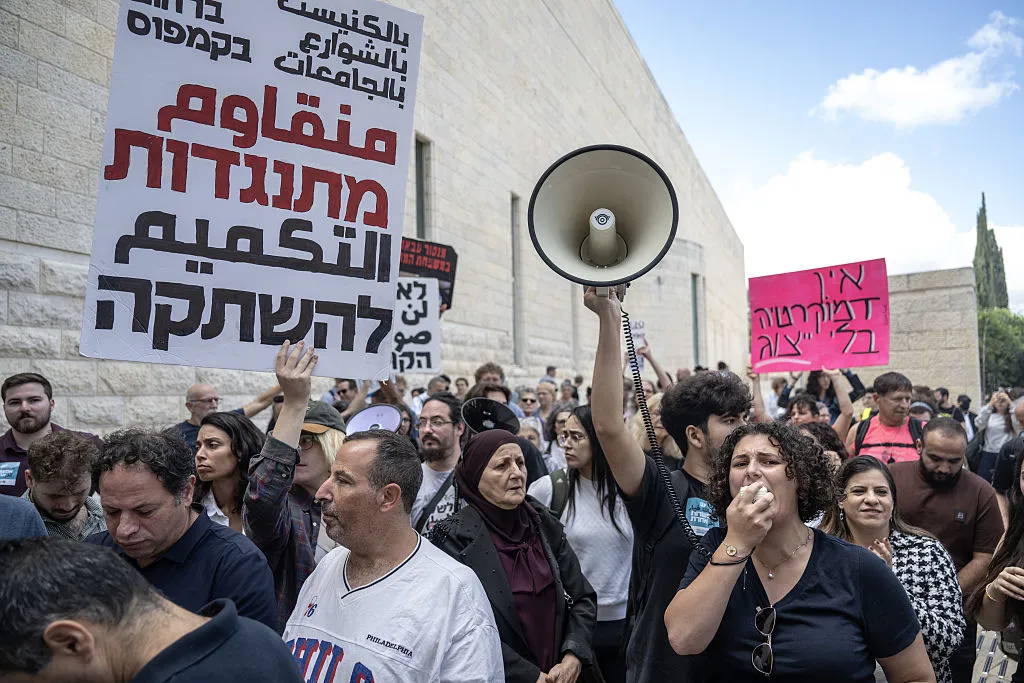
Israel’s Supreme Court unanimously reversed a ban on Arab parties from participating in elections slated for the end of October. The Supreme Court ruling Friday came after a move last week by Israel’s central elections committee, a body controlled by Prime Minister Benjamin Netanyahu and members of his right-wing bloc, to prohibit all four Arab-majority parties registered in the Oct. 27 vote. The disqualification applied to the United Arab List, commonly known as Ra’am and led by Mansour Abbas, and the Joint List, a coalition of three Arab parties.
“We will go to the ballots in droves,” the Joint List said a statement following the Supreme Court ruling, in a reference to remarks by Netanyahu in 2015. In a last-ditch effort to mobilize his base 11 years ago, the prime minister warned that the Israeli Right was in danger as Arab-Israelis flocked to the polls “in droves.”
Earlier this week, the Supreme Court announced that it would likely uphold a related central election committee ban against Sami Abu Shehadeh, an Arab-Israeli politician. The court said Abu Shehadeh might have crossed the threshold for supporting a terrorist group, citing an op-ed he wrote immediately after the Oct. 7, 2023 Hamas attack, which described the assault as a natural response to Israeli policy. Abu Shehadeh on Friday officially withdrew from the election, saying in a video announcement that “they will not ease our cause, our voice, or our right to engage in political activity.”
In the first election since the attack, anti-Arab rhetoric has featured in the campaigns of many right-wing parties, which say Arab influence in the government would be a national security threat. Many point to the Ra’am party, which was a member of Israel’s ruling coalition between 2021 and 2022, the first time an Arab party had formally taken such a step. In this election, Yoav Segalovich, a Jewish-Israeli and formerly a high-ranking police official, is running as deputy leader of Ra’am in an attempt to attract both Jewish and Arab voters. Arab-Israelis make up some 20% of the electorate, but in a race of tight margins they are expected to play a pivotal role. According to most public opinion polls, neither Netanyahu’s right-wing coalition, nor his main opponent, former general Gadi Eisenkot, are expected to clinch a 61-seat majority in the 120-seat parliament. That means negotiations would likely follow with other parties to form a government.
Source: Bloomberg Markets · Summarized by HeadlinesBriefing