
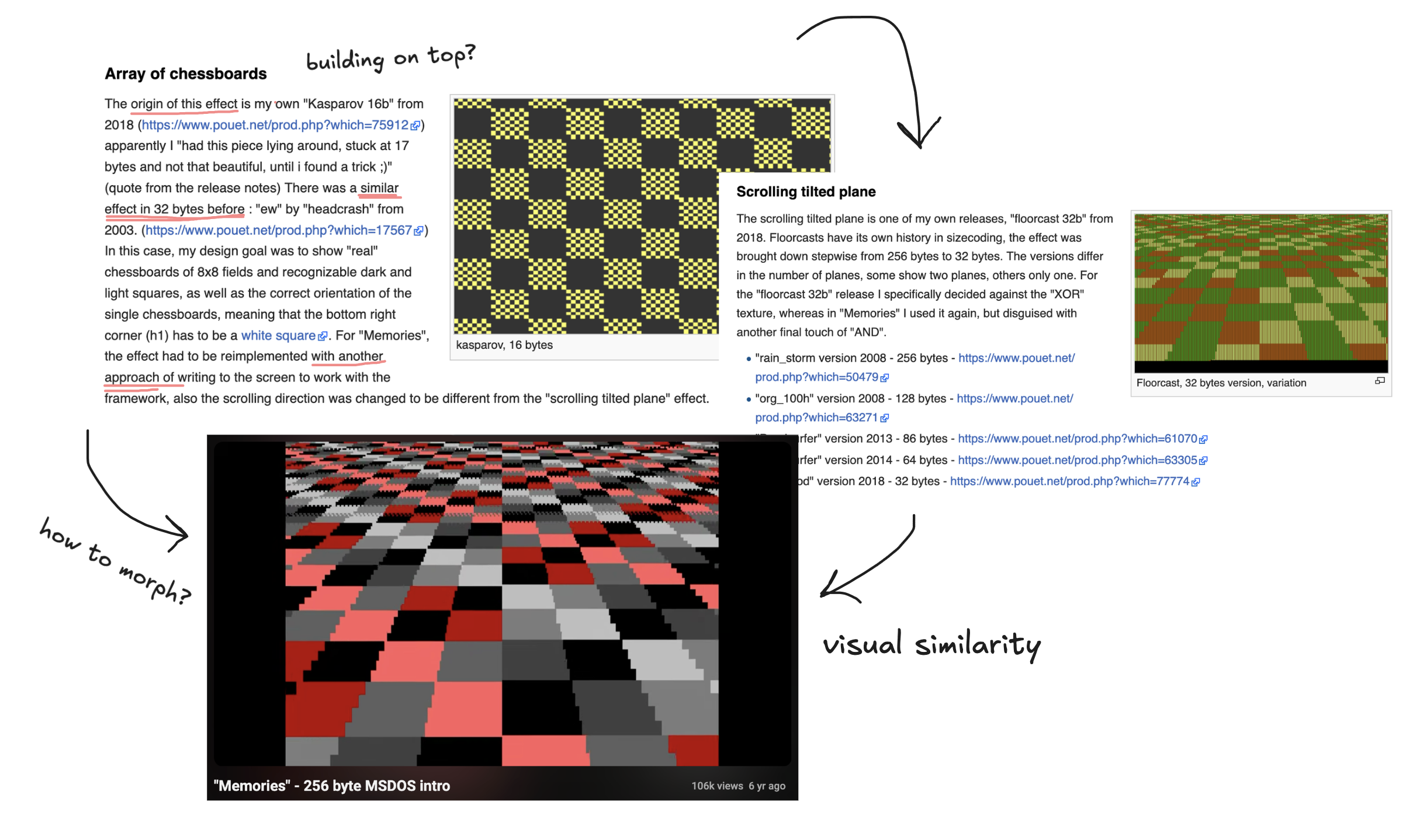
The author explores Hell Mood's MS-DOS demo Memories and discovers Dwitter.net, a platform for 140-character JavaScript demos. Noticing that popular dweets share code substrings but diverge visually, they draw a parallel to linguistic productivity: a finite set of rules yields astronomical variations.
Autoregressive language models could sample plausible continuations of unfinished dweets, revealing unexplored creative directions. Frustrated by their own inability to complete demos, the author sees an autocomplete tuned to dweet syntax as a solution.
Inspired by Mithil Vakde's work, they consider injecting personal aesthetic preferences as a prior via preference comparisons. Funding a GPU rental through GitHub Sponsors, they begin post-training a model.
Initial synthetic data from Claude Sonnet 5.5 proves aesthetically lacking. The author instead scrapes 25k Dweets via Dwitter's API to build a modest, authentic dataset for training.
Source: Hacker News · Summarized by HeadlinesBriefing