
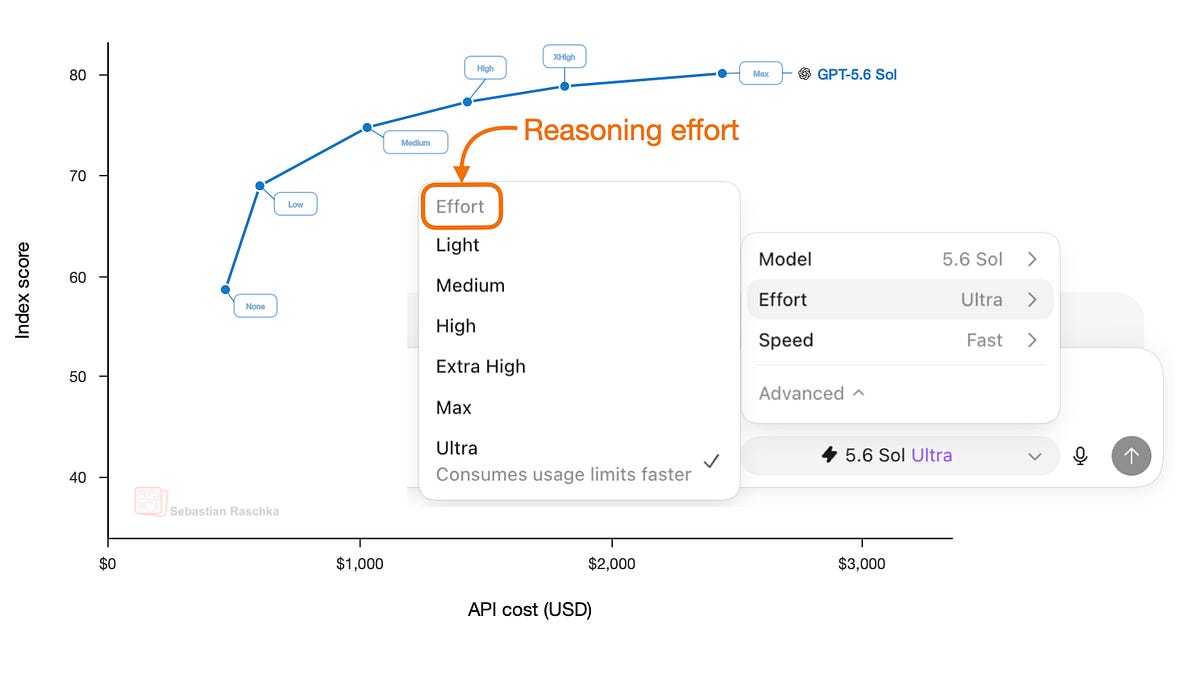
Two years after OpenAI's o1 popularized LLM-based reasoning models, the field has advanced significantly. Deep Seek-R1 introduced reinforcement learning with verifiable rewards (RLVR) for training these models. The recent release of OpenAI's GPT-5.6 model family, with multiple reasoning-effort settings, highlights the permanence of reasoning models in AI.
These models don't "reason" like humans but generate intermediate traces to solve tasks step-by-step. Performance improvements come from training scaling and inference scaling. RLVR, used by models like Deep Seek-R1, trains LLMs using reward signals for verifiable domains like math and code, enabling them to learn reasoning processes and self-correct.
Inference scaling, another method, involves spending more compute during usage to enhance answers. Techniques like self-consistency, where multiple model queries are averaged, can be applied on-demand. Deep Seek Math-V2 exemplifies extreme inference scaling on a specialized reasoning model.
While formatting tokens like <think></think> are cosmetic, the underlying ability to generate reasoning traces is achieved through methods like RLVR, making most current LLMs effectively reasoning models. The development of multi-effort reasoning models, similar to GPT-5.6, is a key area of focus.
Source: Hacker News · Summarized by HeadlinesBriefing