
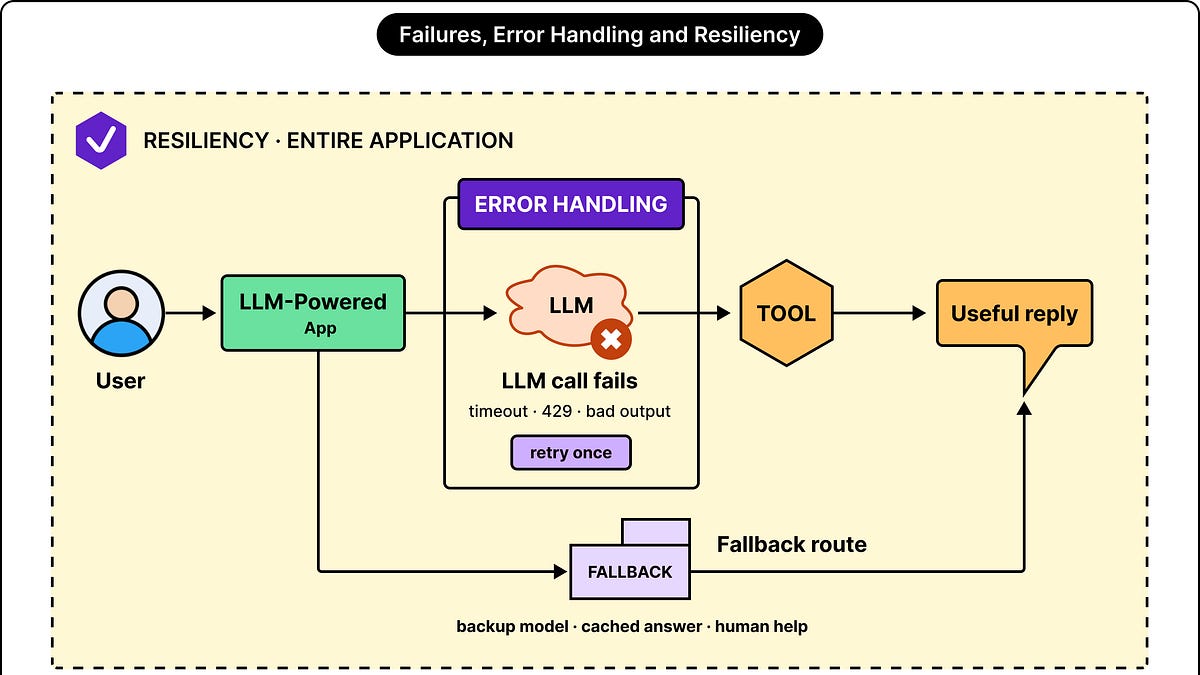
LLM-powered applications differ from traditional software by integrating large language model responses into their workflow, such as chatbots answering queries or document processors extracting data. While the request flow appears simple — user request, prompt to LLM, response processing — multiple failure points exist. Network issues, provider rejections, invalid JSON outputs, hallucinations, and latency can all disrupt operations.
Error handling involves deciding appropriate actions when failures occur: retrying requests, showing explanatory messages, using backup models, or logging for investigation. Resiliency means the application continues functioning despite partial failures, known as graceful degradation. For example, a travel assistant might switch to a smaller backup model if the primary LLM fails, then fall back to pre-generated destination guides.
Production systems must classify failure types to respond correctly. Key strategies include proper retry logic with exponential backoff, timeout and deadline management, circuit breakers to prevent cascade failures, rate limiting and concurrency controls, idempotency for safe tool calls, and streaming response handling. These techniques ensure controlled failure modes rather than application crashes.
Source: ByteByteGo · Summarized by HeadlinesBriefing