
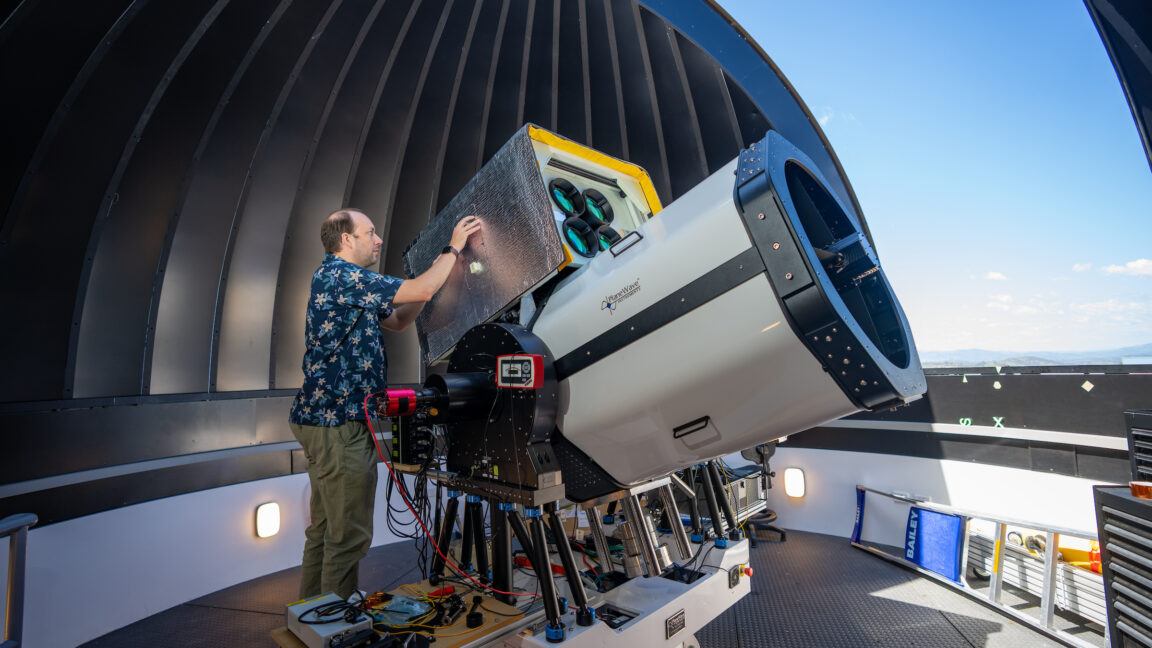
NASA’s Artemis II mission tested a low‑cost optical terminal to receive laser data from the Moon. Engineers in Ohio and Maryland fitted a 70‑cm telescope from Observable Space with a Quantum Opus backend. Deployed at Mount Stromlo, Australia, the system hit the design ceiling of 260 MB/s during the flight and streamed data to mission control in real time.
The Opus One detector uses superconducting nanowire single‑photon sensors, a technology that pushes the limits of laser‑to‑space bandwidth. Quantum Opus, co‑founded by former astronaut Josh Cassada, built the photon‑counting hardware. Cassada said the system lets users count photons without cryogenic expertise, enabling rapid deployment for quantum‑computing research and accelerates data‑intensive experiments worldwide for scientists and engineers.
Deploying an off‑the‑shelf telescope dramatically cuts expenses compared to custom ground stations, which can cost millions. By proving that a 70‑cm aperture can match the 260 MB/s target, NASA demonstrates that scalable, low‑budget laser links are viable for future lunar and Martian missions. This opens the door to broader scientific payloads and encourages private companies to invest in complementary technologies today.
With this test, NASA confirms that commercial optics can meet the high‑throughput demands of deep‑space exploration. The partnership between Observable Space and Quantum Opus illustrates how industry players can accelerate space‑to‑ground laser communication, potentially reshaping data transfer strategies for upcoming missions. This milestone signals a shift toward more agile, cost‑effective communication infrastructures across the space sector for all stakeholders.
Source: Ars Technica · Summarized by HeadlinesBriefing