
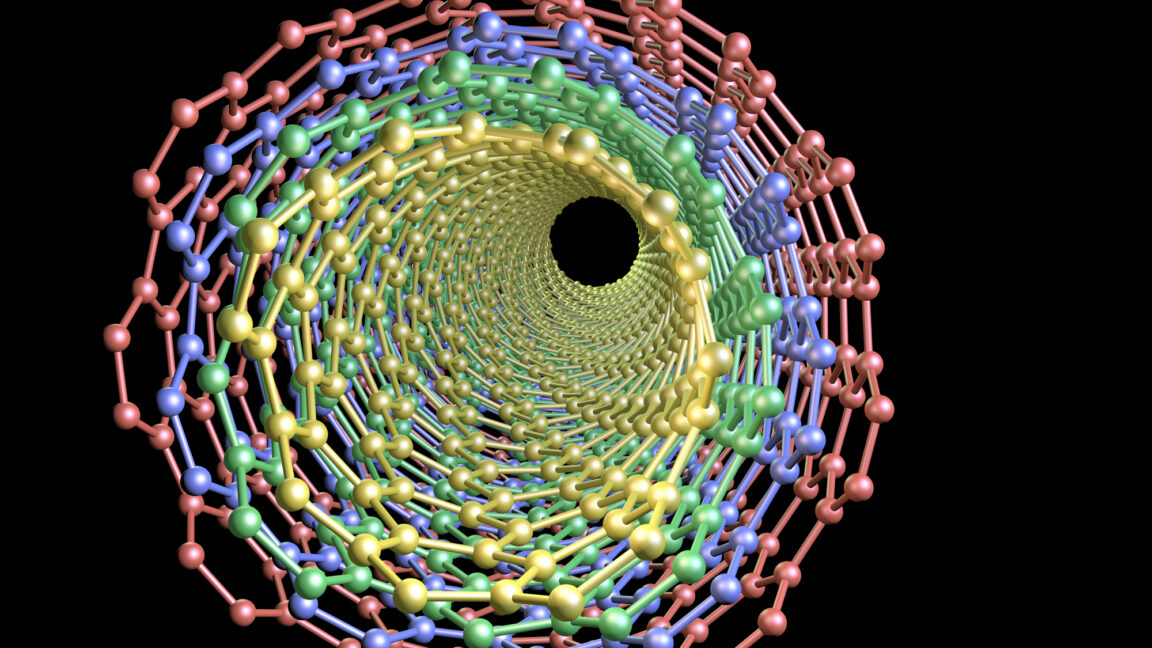
Researchers have made progress in developing carbon nanotube wiring that approaches copper's conductivity levels. A Spanish team successfully doped double-walled nanotube fibers with tetrachloroaluminate, boosting their current-carrying capacity by up to 15 times. These nanomaterials have long been considered promising alternatives to traditional metals but faced practical limitations in real-world applications due to synthesis challenges and current-carrying restrictions.
The doping process increased conductivity to approximately 70% of aluminum's levels (about half of copper's performance). When normalized by density, the modified nanotubes actually outperformed copper while maintaining the material's inherent strength, which exceeds that of copper or aluminum. Researchers confirmed the chemical changes occurred without altering the fiber's physical size, preserving the structural integrity of the nanotube bundles.
Despite these advances, the tetrachloroaluminate dopant proves unstable in normal environmental conditions, reacting with water vapor and limiting the material's useful lifespan to weeks rather than decades. The research demonstrates potential for future applications where weight savings matter, such as high-capacity transmission lines, provided scientists can develop more stable alternatives that maintain the conductivity improvements.
Source: Ars Technica · Summarized by HeadlinesBriefing