
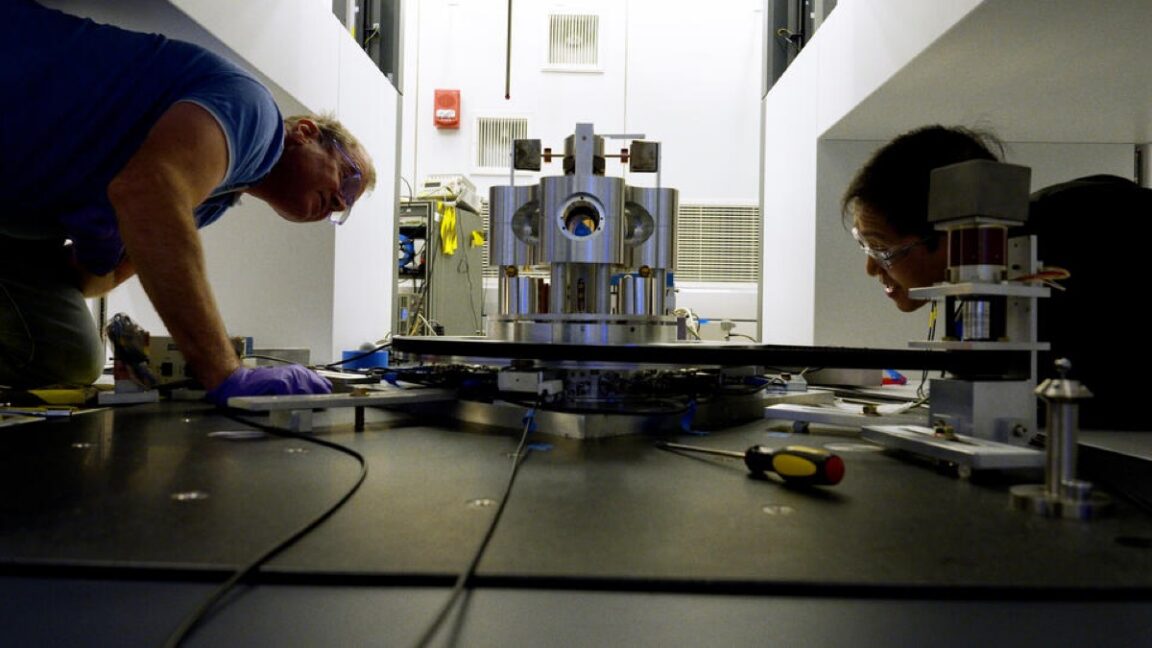
Physicists continue their 225-year quest to precisely measure the gravitational constant, or Big G. A decade-long experiment at the National Institute of Standards and Technology has replicated a controversial 2007 measurement that yielded different values from other experiments. The NIST team used a sophisticated torsion balance with eight metal cylinders to track gravitational torque, testing with both copper and sapphire materials.
The resulting value of 6.67387×10^-11 m³/kg/s² is 0.0235 percent lower than the original BIPM result, failing to resolve the long-standing discrepancy. Gravity remains the weakest of the four fundamental forces, making laboratory measurements particularly challenging due to background noise from Earth's gravitational field. Despite these difficulties, precise measurements lead to better instruments for detecting small forces.
NIST physicist Stephan Schlamminger emphasizes that every measurement matters because "making an accurate measurement is a way of bringing order to the universe, whether or not the number agrees with the expected value." The persistent variation in Big G values continues to frustrate precision metrology, though each experimental refinement contributes to our understanding of this elusive fundamental constant.
Source: Ars Technica · Summarized by HeadlinesBriefing