
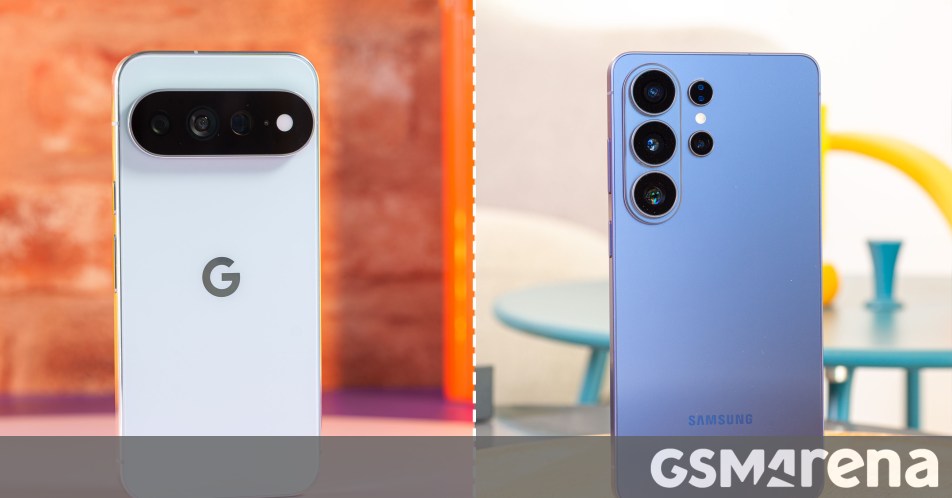
Looking for a premium Android flagship? The Google Pixel 11 Pro XL and Samsung Galaxy S26 Ultra are two compelling options, but they take rather different approaches. Google's latest Pixel emphasizes its camera experience and tightly integrated Google software, while Samsung offers more powerful hardware, a broader feature set, and extras like Privacy Display and the S Pen. And due to the fact that the Galaxy is now the older model, it can now be found at a lower price.
For starters, you can compare the complete specs sheets or directly continue with our editor's assessment. Size comparison When it comes to design, both Google and Samsung seem stuck in their ways. Neither brand goes beyond standard IP68 water resistance, and both continue to refine - or simply recycle - the same design language across generations. The Pixel 11 Pro XL relies on Gorilla Glass Victus 2 protection and an aluminum frame. Its slightly smaller screen translates to a slightly smaller footprint, but it's 12 grams heavier and features a far more prominent camera bar than the Ultra. The Pixel 11 Pro XL also features Hi Light, a set of multicolor LEDs inside the camera flash that glow in different patterns when interacting with Gemini or receiving calls from favorite contacts, with customizable colors for each contact. It's a neat idea, but its functionality is surprisingly limited, making it feel more like a gimmick than a genuinely useful feature. The Galaxy S26 Ultra's larger display makes it taller and wider, but its lighter weight, superior Gorilla Armor 2 glass, and the more streamlined camera layout make it the cleaner design overall. Winner: Galaxy S26 Ultra.
Display comparison The Pixel 11 Pro XL packs a 6.8-inch LTPO OLED with 486ppi pixel density, 120Hz refresh rate, and HDR10+ support. It is protected by Gorilla Glass Victus 2. We measured 2,333 nits of maximum brightness with a 75% fill of the screen and 3,118 nits of peak brightness with a 10% fill. The Galaxy S26 Ultra features a larger 6.9-inch Dynamic AMOLED 2X display with a 500 ppi density, a 120Hz refresh rate, and HDR10+ support. Just like Google, Samsung did not take the extra step of offering proper 10-bit color depth on its panel. However, it includes things the Pixel does not: a Privacy Display feature and S-Pen support. The Galaxy screen also offers superior protection with Gorilla Armor 2. Its brightness measurements are less impressive, though still very good: 1,480 nits max brightness with a 75% fill of the screen and 2,800 nits peak with a 10% fill of the screen. Winner: Galaxy S26 Ultra. The Pixel gets considerably brighter in our tests, but the Galaxy counters with better anti-reflective properties, Gorilla Armor 2 protection, Privacy Display and S Pen integration.
Battery life The Pixel 11 Pro XL is powered by a 5,115m Ah, while the Galaxy S26 Ultra has a 5,000m Ah cell. The two phones posted similar Active Use Scores on our battery life tests – 16:45h vs 16:23h. The Pixel offers longer web browsing endurance, while the Galaxy has longer call time. Winner: Tie. Charging speed The Pixel 11 Pro XL supports up to 45W fast wired charging and up to 25W fast wireless charging, and most importantly, it has the needed magnets integrated. It's got a new Extreme Charging mode, which can be enabled for individual charging sessions when the battery level is below 50%, and it will provide a more aggressive charging curve. The charging speeds we've listed are achieved with this Extreme charging mode turned on. The Galaxy S26 Ultra supports up to 60W fast wired charging and up to 25W wireless charging, but it requires the use of a case with magnets to reach that. Winner: Galaxy S26 Ultra.
Source: GSMArena · Summarized by HeadlinesBriefing