
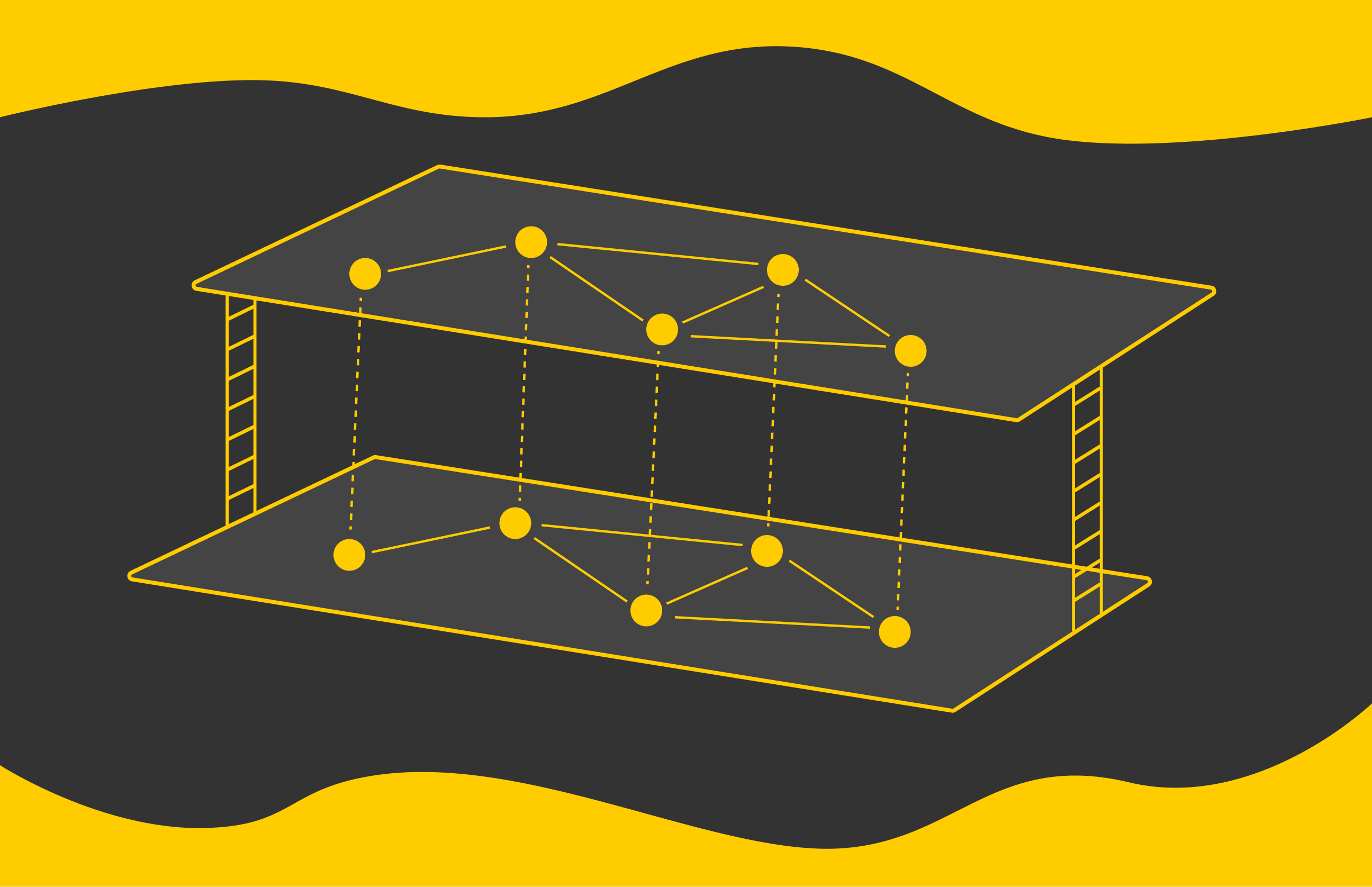
Neural networks excel at learning complex functions but typically ignore relationships between input data parts. Graph Neural Networks (GNNs) address this by applying neural networks to graph structures — sets of objects with defined relationships like molecules, social networks, or traffic systems. GNNs preserve graph structure while transforming node states, enabling tasks such as node, edge, or graph classification, and generalizing to unseen graph structures. A key application includes antibiotic discovery.
Graph Convolutional Networks (GCNs) extend the convolution concept from images to graphs. Just as image convolutions combine a pixel with its neighbours, GCNs aggregate a node's features with those of its adjacent nodes. Graphs generalize images, where pixels connect to up to four neighbours. GNNs typically use 2–4 layers; more layers risk oversmoothing, where node representations become indistinguishable. Each layer independently updates node feature vectors via aggregation functions.
Message Passing Neural Networks (MPNNs) provide a unified framework where nodes exchange messages with neighbours to update their states. Graph Attention Networks (GATs) enhance this by using attention mechanisms to weight neighbour contributions dynamically, allowing the model to focus on the most relevant nodes. These architectures form the foundation of modern graph representation learning.
स्रोत: Towards Data Science · HeadlinesBriefing द्वारा सारांशित