
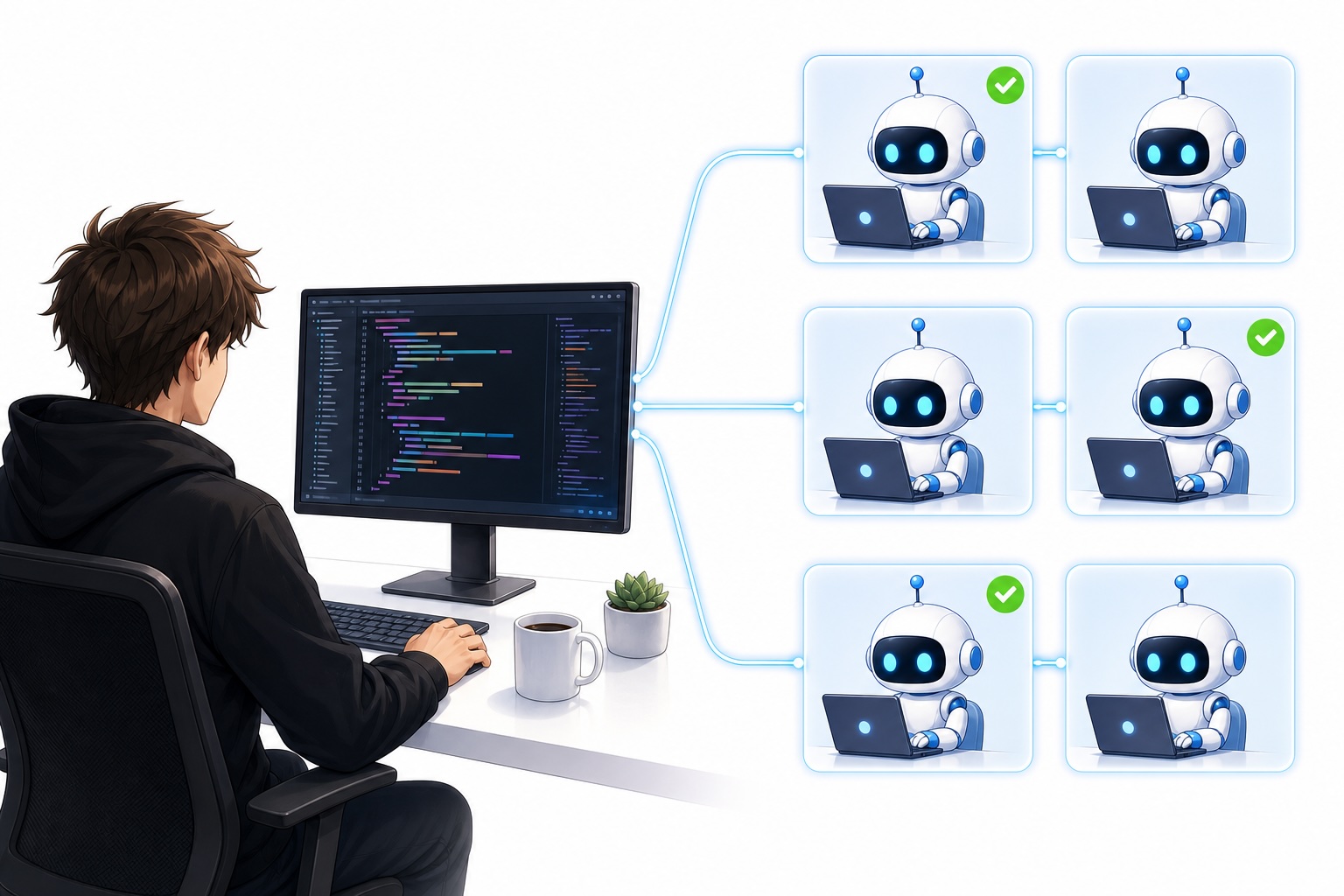
Now that we have coding agents that are extremely proficient at writing code, I experience a lot of smaller tasks coming up that have to be fixed. This is a general observation I've made from working with startups and applications: because the effort to write code has gone down so much, the threshold for providing product feedback has lowered, and requests for quick fixes have vastly increased. Of course, when doing this, you can spin up one Claude Code or Codex session per task.
However, you start having problems once you receive 50 to 100 tasks per day, where you obviously don't want to spin up that many separate coding sessions. At the same time, you don't necessarily want to put everything in one session, since you can run into context-length limits and the model may struggle to orchestrate all the tasks effectively. This is an issue I started experiencing myself a lot, and I just started developing a philosophy and methodology to solve hundreds of smaller tasks in an effective manner.
In this article, I'll take you through the methodology that I use on a daily basis to work more effectively with my Claude Code sessions to solve a lot of coding tasks. This infographic highlights the main contents of this article and discusses how to effectively solve a large number of smaller coding tasks using coding agents such as Claude Code or Open AI Codex, Image by Chat GPT. Why optimize how to solve smaller tasks As always, I'll take you through why you should care about optimizing how to solve smaller tasks.
You might think that coding agents have become so efficient that simple quick fixes are something you can just throw at a coding agent and it immediately solves everything for you, and you don't really have to think about it. To some extent, this is true. I mean, you can, in many cases, just fire off tasks, for example, a Linear task to a coding agent, and it will, in many cases, be able to solve it itself and drive it to dev and production with very little human interaction.
However, the problem arises when you start having a lot of these smaller tasks coming in, which can happen because of: Bugs Smaller feature requests Design updates and many other cases. Thus, you need a strong methodology for working through all of these tasks, verifying they're solved in a correct manner, and marking them done. Some smaller tasks can be done fully autonomously by coding agents.
However, I also found that a lot of similar-looking tasks are a bit ambiguous. If you simply ask a coding agent to fix such a task without any more input, you might find that the coding agent did not actually solve the problem, or in many cases, even worse, that the coding agent did something it wasn't supposed to do and changed a part of your application that you didn't intend to change. Due to the challenges I mentioned here: Solving a lot of smaller tasks Ambiguities in smaller tasks You need a good methodology for completing all these tasks, which is what I'll cover in the following sections.
My coding methodology Now I'll cover my coding methodology to more effectively solve a lot of these tasks. I'll take you through my high-level pipeline and the philosophy and mindset that I have for solving these tasks. The pipeline looks as follows: The issue is posted, typically through Slack An agent picks up the task and creates a Linear issue for it I have a Claude Code session to deal with all of these tasks, typically for a specific time period, for one specific day in my case.
I triage the tasks through my Claude Code session. If it's a simple quick fix, I use the Claude Code session to fix it. If it's a bigger issue, I have the agent in the session create a hand-off up front and work on a completely separate thread to solve the issue because it needs more human interaction.
I make Claude Code create an HTML report of all the smaller issues that we want to work through. If it has any questions for me, I need to clarify them and give it guidelines on how to complete t...
Source: Towards Data Science · Summarized by HeadlinesBriefing