
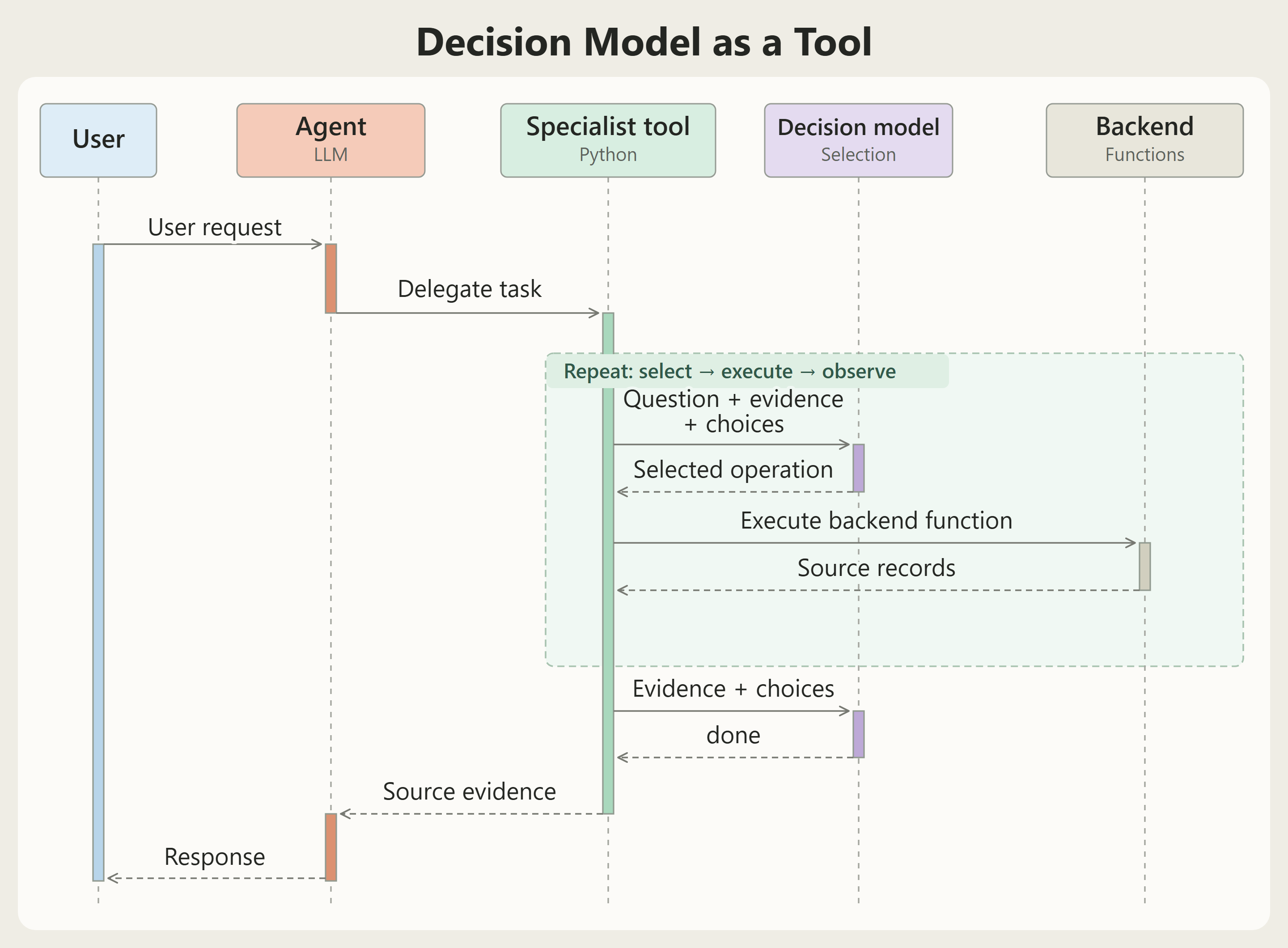
We turn an LLM into an agent by giving it tools to look things up, call APIs, and take action. Traditionally, agents make each intermediate decision in a loop, adding time and cost. The decision-model-as-a-tool pattern embeds a decision model inside a tool, allowing it to drive the workflow: pick actions, evaluate results, and continue until sufficient evidence is gathered, then return to the agent.
This approach reduces LLM calls, lowering cost and latency. For a customer-support agent investigating a delayed order, the agent delegates to an order-specialist tool containing a decision model that handles routine steps like checking order status, warehouse notes, and shipping options.
The agent focuses reasoning on where it matters, while the decision model manages the investigation loop. This pattern is particularly effective when intermediate decisions are straightforward and routine.
The post demonstrates building a customer-support agent that investigates delayed order ORD-1042 and finds ways to meet a Friday, October 23 delivery deadline.
Source: Towards Data Science · Summarized by HeadlinesBriefing