
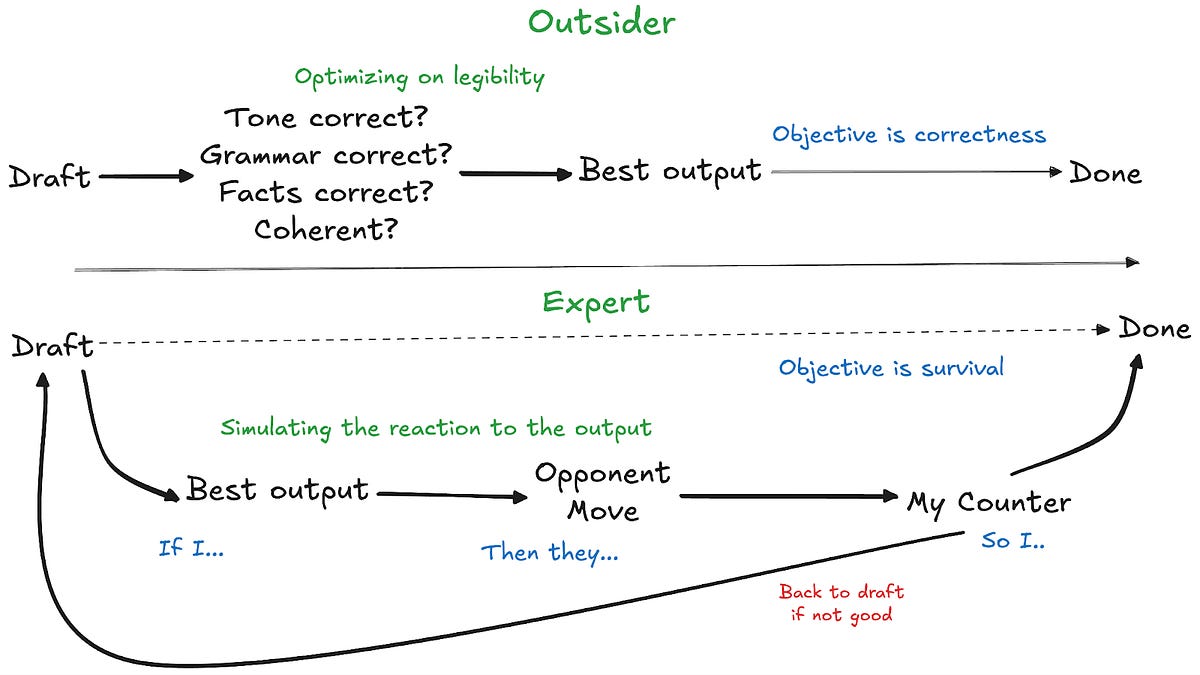
A new essay explores why today's AI systems excel at pattern matching but fail at adversarial reasoning. While large language models can generate convincing text, they lack the world models that human experts use to anticipate how adversaries will exploit vulnerabilities. The piece argues that intelligence alone isn't sufficient - what matters is simulation depth and the ability to model other agents' hidden states and incentives.
Drawing from examples like trial lawyers and traders, the author demonstrates how experts see vulnerabilities that AI misses. A simple Slack message illustrates this: an LLM might craft a polite request, but an experienced coworker knows it will get deprioritized. The key difference isn't just knowledge - it's running simulations of how the message will be received by someone with competing priorities and triage heuristics. This gap becomes critical in adversarial situations where opponents have private information and adapt to your actions.
The essay contrasts this with perfect-information games like chess, where optimal moves can be calculated from board state alone. But when other agents have hidden information - as in poker or financial markets - you need to model their models of you. The author argues we're moving from the age of scaling to the age of research, with adversarial reasoning emerging as a crucial frontier. Current benchmarks like ARC-AGI and Code Clash are starting to model these challenges as games, but solving them requires more than pattern matching.
Source: Hacker News: Front Page · Summarized by HeadlinesBriefing