
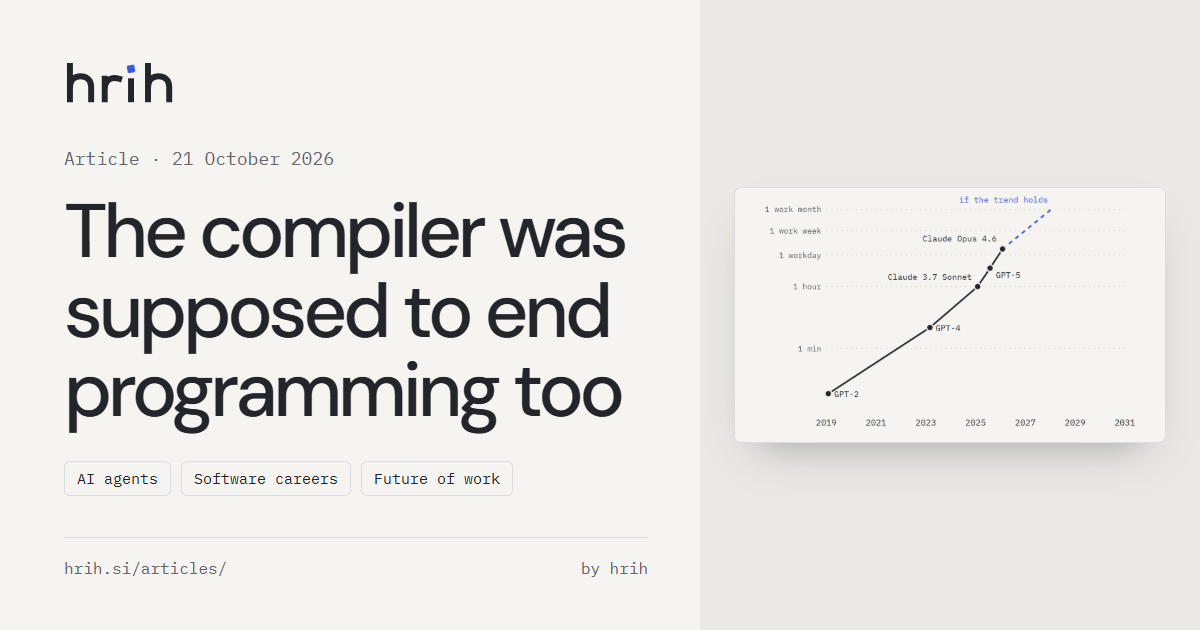
It is 7:40 on a Tuesday morning in 2031, and you have not written a line of code yet. While you slept, four agents worked through the backlog you sorted the previous afternoon. Three finished and left pull requests, each with tests, a short recording of the feature working, and a note about the parts they were unsure of. The fourth stopped at 2:13 a.m. and asked a question: the spec says refunds go back to the original card, but this customer's card expired in March. What should happen? The agent could write refund code all day, but it cannot decide what the company owes a customer in that situation, so it stopped and asked.
Your morning goes like this. You read three pull requests, talk to someone in support, and write the rule down so clearly that nobody, human or machine, has to guess again. The scenario is imagined, but agents that work unattended overnight exist today. One runs on the author's own machine every night at ten, inventing a small project, building it, and testing it, and the author learns what it made over breakfast. That experiment became Rule Safari, a live project on the site.
Is this the end of programming? People have asked that for more than seventy years. In November 1954, IBM's Programming Research Group wrote that FORTRAN "should virtually eliminate coding and debugging." FORTRAN shipped in 1957 and did eliminate a kind of coding, since almost nobody translates formulas into machine instructions by hand anymore. Debugging survived. What the compiler really did was remove one tedious layer and move the job up a level. Programs got cheaper to write, so people wanted more of them. The pattern has repeated since, and agents may be the next step in it.
Source: Hacker News · Summarized by HeadlinesBriefing